
There is so much to the story of Joseph in Genesis, and it’s connections throughout the Bible, to Jesus, and to us! Where to start?
Joseph Comparison to Jesus
There has been a lot written about this, and you can easily find online very long lists with many parallels between Joseph and Jesus, so I’ll just list some big ones here:
- Both were the first born of their mothers (Rachel, Mary) and loved dearly by their fathers (Joseph by Jacob, Jesus by God the Father)
- Joseph was a literal shepherd, and Jesus is called the Good Shepherd (John 10:11-14, Ezekiel 34, Hebrews 13:20)
- Joseph had prophetic dreams that he would rule over his family (families of Jacob who would become the tribes of Israel), and there are many prophecies about Christ/Jesus becoming the ruler of Planet Earth (Daniel 7:13-14, Psalms 2, just to cite a couple)
- Joseph was betrayed by his brothers, Jesus was betrayed by one of His disciples and rejected by His own people
- Joseph was sold for the price of a slave, Jesus was betrayed for the price of a slave
- Joseph went to Egypt as a slave, Jesus’ parents fled to Egypt just before King Herod wiped out the male babies in Bethlehem under 2 years of age.
- Joseph was falsely accused by Potiphar’s wife, Jesus was accused by false witnesses
- Joseph was in prison with two men who Pharaoh sent there, Jesus was hung on the cross with two men the Romans put there. In both cases, one of the men was forgiven while the other died without forgiveness
- Joseph had to go through slavery and imprisonment before being made second to the Pharaoh in ruling Egypt. Jesus lived a humble life and died as a criminal before being glorified in Heaven
- Joseph’s brothers received the favor of the Pharaoh because of Joseph, not because of themselves. We receive God’s favor because of Jesus, not because we deserve it.
The Big Picture
There are two big reasons the Bible gives for the Israelites taking a 400 year side trip in Egypt before finally settling in the land God promised to Abraham. Joseph being sold a slave set off that chain of events.
The first reason: A terrible seven-year famine was coming which would devastate the entire Middle East. God used the betrayal of Joseph by his brothers to save many lives. God warned Pharaoh (through Joseph) seven years before it happened, and they had time to store up enough food, not only for Egypt, but to feed other nations. People from many surrounding countries came to Egypt for food. Joseph’s words to his brothers after Jacob passed away:
“But as for you, you meant evil against me; but God meant it for good, in order to bring it about as it is this day, to save many people alive.” Genesis 50:20
The second reason is quite shocking. God explained this to Abraham, many years before Joseph was taken to Egypt.
Then He said to Abram: “Know certainly that your descendants will be strangers in a land that is not theirs, and will serve them, and they will afflict them four hundred years. And also the nation whom they serve I will judge; afterward they shall come out with great possessions. Now as for you, you shall go to your fathers in peace; you shall be buried at a good old age. But in the fourth generation they shall return here, for the iniquity of the Amorites is not yet complete.” Genesis 15:13-16
This is surprising because we see so much in the Bible about the Children of Israel being God’s chosen people, and how He blessed them and was so patient with them. Here, the same God who rained fire and brimstone down on Sodom and Gomorrah would allow His own chosen people to stay enslaved in Egypt longer because “the iniquity of the Amorites is not yet complete”.
There is a repeating pattern with all humanity, where God gives life, He gives the truth, and He gives time to choose.
“And I gave her time to repent of her sexual immorality, and she did not repent.” Revelation 2:21
This must be remembered when the claim comes up that God commanded genocide when the Israelites drove out the Canaanites. At that time, their wickedness had reached a level that they had to be dispossessed from the land they lived on, and sometimes completely destroyed. Yet God gave them hundreds of years to choose a better path. These nations were all descendants of Noah, and they were not ignorant of God and His ways. We humans don’t see the big picture as God does. Not yet.
Lessons from Joseph’s story for us
Joseph was about 17 years old (Genesis 37:2) when he was sold by his brothers as a slave. He was 30 when he became vice-regent or prime minister of Egypt (Genesis 41:46). That’s 13 years as a slave and then a prisoner.
Somewhere in that 13 years, Joseph could have said, “What’s the use in following God? I try to do what’s right and look where it gets me?” But he didn’t give up and he remained faithful. This took a spiritual connection to God that was stronger than mere logic and philosophy.
God may be preparing you
While that’s a long time to wait for justice while being treated unfairly, in hindsight we can see that God was preparing Joseph for his future role as vice president of Egypt, to use a modern United States equivalent. Potiphar, who bought Joseph in Egypt, was “an officer to Pharaoh, and captain of the guard”. This meant that while Joseph was promoted, and eventually placed in charge of everything Potiphar owned, he also overheard and was exposed to Potiphar’s dealings with the palace.
Once Potiphar’s wife accused Joseph of attempting to rape her, despite the fact it was she who tried to seduce Joseph, he was thrown in prison. Keep in mind, if Potiphar really believed Joseph was guilty, he would have killed Joseph. But he had to save face, rather than believe a slave over his wife. And the same thing happened in the prison that happened in Potiphar’s house:
“And the keeper of the prison committed to Joseph’s hand all the prisoners who were in the prison; whatever they did there, it was his doing. The keeper of the prison did not look into anything that was under Joseph’s authority, because the Lord was with him; and whatever he did, the Lord made it prosper.” Genesis 39:22-23
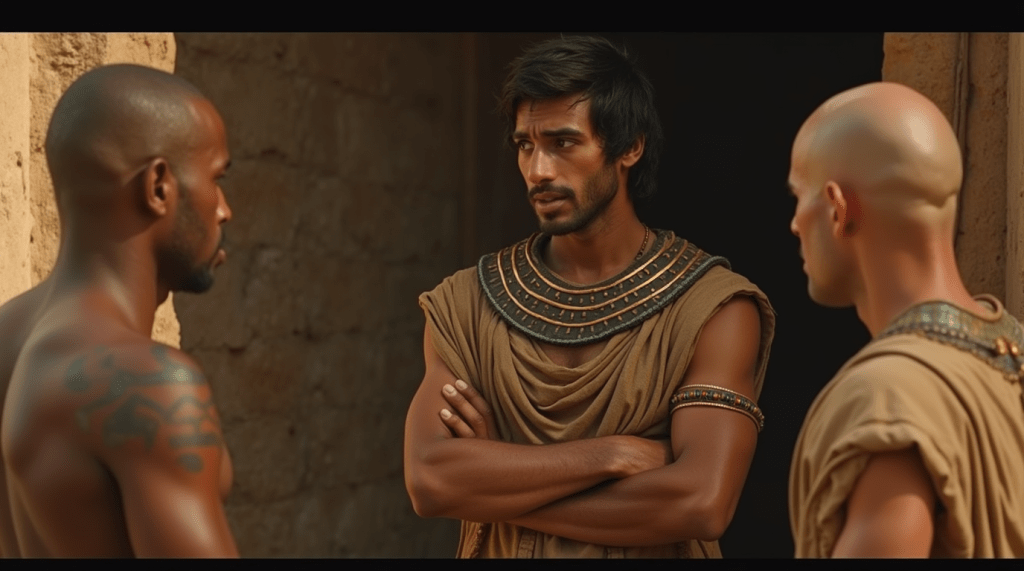
In the experience of running Potiphar’s house, then running the prison, Joseph learned how to manage people and operations, and many other skills he would need when he became prime minister of all Egypt.
Whose Law?

I think it’s fascinating that when Potiphar’s wife told Joseph “Lie with me!”, this was his response:
“How then can I do this great wickedness, and sin against God?” Genesis 39:9
Sin against God? Wouldn’t Joseph be wronging Potiphar if he went to bed with his wife? While we’re at it, we should ask what is the definition of sin?
“Whoever commits sin also commits lawlessness, and sin is lawlessness.” 1 John 3:4
Ah! So sin is breaking the law. And the law against adultery is God’s seventh law in the Ten Commandments.
“The man who commits adultery with another man’s wife, he who commits adultery with his neighbor’s wife, the adulterer and the adulteress, shall surely be put to death.” Leviticus 20:10
Now hold on! The Ten Commandments were not delivered at Sinai for another 400 years, right? How did Joseph know this was a sin against God? Abraham knew and obeyed God’s laws and commandments (Genesis 26:5), and he obviously passed those on to his sons and grandsons. The children of Noah, Shem, and Abraham knew God’s laws. The children of Ham (including Egypt) also had this knowledge, but chose to forget and followed false gods.
If it’s bad enough to warrant the death penalty, that explains why Joseph called it a “great wickedness”. But even modern movies illustrate how heartbreaking, intensely stressful, complicated, and even dangerous committing adultery is. This causes humans nothing but long-term suffering and misery, for a few moments of pleasure, which is why God outlawed it.
Joseph’s Brothers
This is how you know Joseph was led by God’s Spirit. Now he’s been the prime minister of Egypt for 9 years, and his half-brothers (the sons of Leah) show up to buy food during the famine. Last time he saw them, more than two decades ago, they were selling him off as a slave to Ishmaelite traders. Now the roles are reversed, and he has power over them.
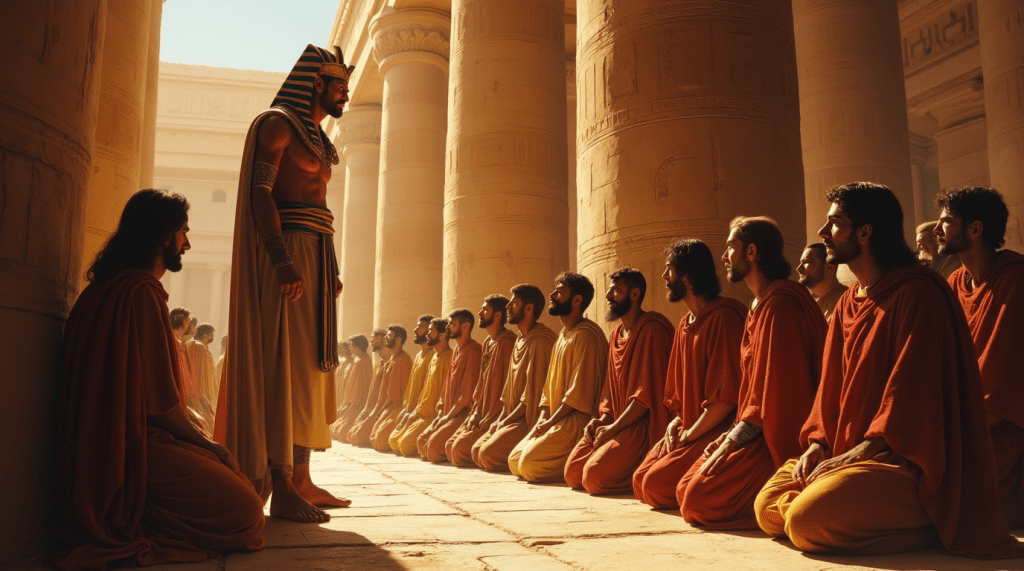
He did test them, accused them of being spies, put them in prison for three days. Then he held Simeon in prison as hostage until they brought his younger brother Benjamin as proof they were not spies. Then he let them go and put all their money back in their grain sacks. On their second visit, when he saw that they had changed enough to substitute themselves in Benjamin’s place, he revealed his identity and forgave them.
“And he said again, “I am Joseph, your brother, whom you sold into slavery in Egypt. But don’t be upset, and don’t be angry with yourselves for selling me to this place. It was God who sent me here ahead of you to preserve your lives. This famine that has ravaged the land for two years will last five more years, and there will be neither plowing nor harvesting. God has sent me ahead of you to keep you and your families alive and to preserve many survivors. So it was God who sent me here, not you! And he is the one who made me an adviser to Pharaoh—the manager of his entire palace and the governor of all Egypt.” Genesis 45:4-8, NLT
Incredible! No revenge on them for ruining his life? No “how could you be so cruel to your own brother?” Just glorifying God and forgiving them. And the tribes of Israel became named after these men and their families, along with Joseph’s two sons, Ephraim and Manasseh.
Joseph’s story teaches us that if we remain faithful and loyal to God, even when the evil in this world persecutes us and time drags on, Jesus will come with all the holy angels and gather His people out of the earth.
“Sin will be rampant everywhere, and the love of many will grow cold. But the one who endures to the end will be saved.” Matthew 24:12-13


 God's Work with Planet Earth
Leave a comment