There’s a nearly 400 year gap between Genesis and Exodus where there are no details about events. Moses wrote Genesis partially from oral tradition and memory passed down through the generations, but also from Devine inspiration. Now we come to his part of the story.
Exodus 1:8-14 tells us that at some point after Joseph, who was the number two ruler of Egypt, had passed away, a new pharaoh rose to power “who did not know Joseph”. I’m sure historically, he knew of him, but clearly some time had passed since Joseph had passed away.
The new pharaoh noticed that God was blessing the Israelites (Abraham, Isaac, Jacob’s descendants) just like He had promised. He was fearful about what would happen if Egypt was challenged by another nation.
“And he said to his people, “Look, the people of the children of Israel are more and mightier than we; come, let us deal shrewdly with them, lest they multiply, and it happen, in the event of war, that they also join our enemies and fight against us, and so go up out of the land.” Exodus 1:9-10
So the pharaoh made the Israelites into slaves and made them work very hard to build entire cities (Pithom and Raamses are mentioned in the text).
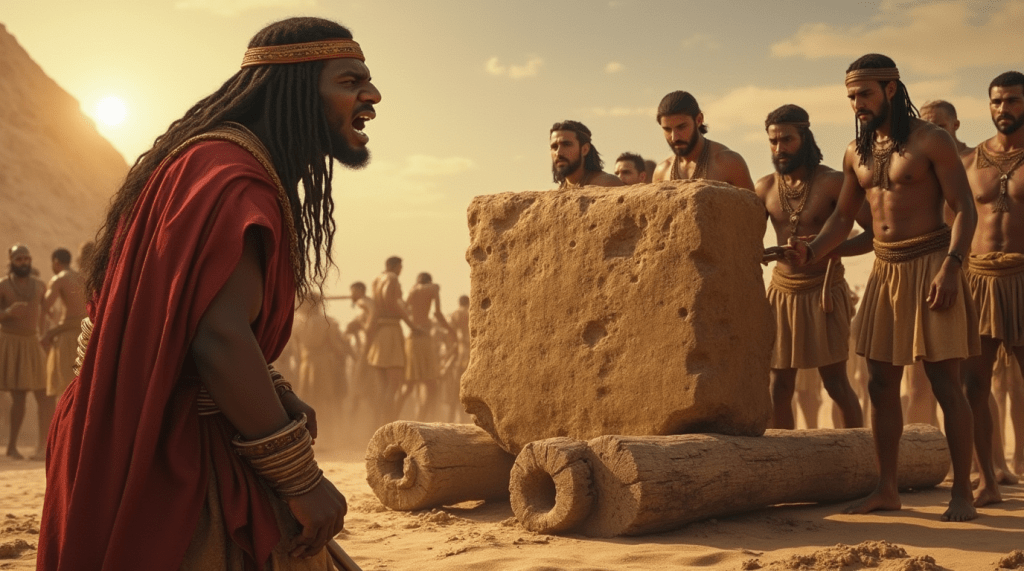
The problem for the pharaoh was, when God is blessing someone, and others try to shut them down or stop that blessing, it doesn’t work. We have to go through very hard and difficult trials in a sinful world, but God can guide and bless us, and our Deliverer is coming.
The Midwives
The Israelites continued to multiply and flourish, in spite of being made to work hard in the baking hot sun. So the pharaoh’s second strategy was to order the midwives who served the Hebrews to kill all their male children when they are born. The midwives “feared God” and ignored the pharaoh.
The text does not specifically state whether the midwives were Egyptian or Hebrew, so we have to rely on some clues.
- Pharaoh would not possibly be dumb enough to expect Hebrew women to kill their fellow Hebrew mother’s babies.
- When the pharaoh confronted the midwives about not killing the male babies, the midwives made the excuse, explaining to him that these “Hebrew women are not like the Egyptian women” (as in, not like us).
- They told the pharaoh that the Hebrew women were “chayeh”, or vigorous and strong, and that these women delivered quickly before the midwives could reach them.
- Because these midwives feared God, He “dealt well with them” and “He provided households for them”. God was already blessing the Hebrews. This was a separate blessing for the non-Hebrew midwives.
Because of these clues, I believe the midwives were Egyptian who worked with Hebrew mothers, and they believed in God enough to defy the pharaoh’s command. Because they refused to kill the babies, God gave them blessings He did not give to other Egyptian women or their households.
The Third Option
At this point, the brutal slavery and attempted, underhanded mass murder of babies has failed to curb the strength and growing population of the Hebrews/Israelites. Now pharaoh resorts to outright invasion of homes and open murder. He ordered that all male Hebrew children should be killed.
Satan inspires men to do this when he realizes a deliverer is on the way. Herod issued the same command for children in Bethlehem when he learned that the Messiah was prophesied to be born there. (Matthew 2:16)
The Children of Israel could endure under brutal forced labor, but now their children are being targeted and slaughtered. This is when they earnestly began to cry out to God.
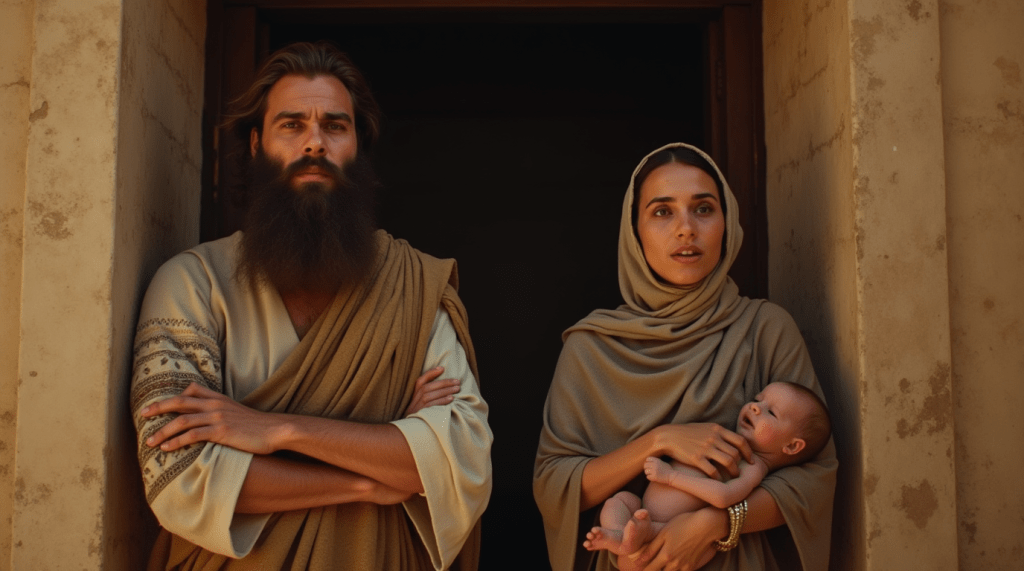
Amram from the house of Levi (one of Jacob’s sons), and his wife Jochebed (also a Levite), had baby Moses at this time. They are unnamed in Exodus 2, but we find their names in Exodus 6:20.
Jochebed, out of desperation, made a woven basket covered with pitch to make it water tight. She put her precious baby in the basket and hid it in the reeds by the Nile river. And her daughter Miriam was set to watch what would happen from hiding.
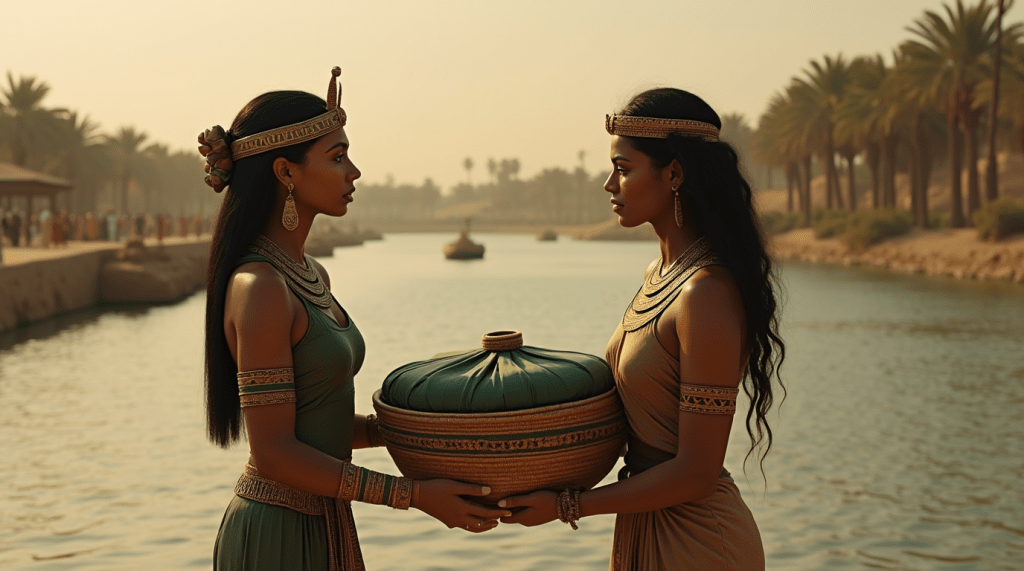
Pharaoh’s daughter spotted the basket in the reeds when she was bathing in the river, and had her maid bring it to her. The princess adopted the baby as her own, even though she recognized this was a Hebrew baby. Miriam offered to get a Hebrew nursemaid for the baby, and the princess agreed.
Because of God’s work and providence impressing Jochebed what to do at the right time, and working in the heart of the princess so “she had compassion on him”, Jochebed had a few short years to teach Moses about God before he was taken to the palace to get the best education Egypt had to offer.
Preparation
Going from being condemned to die before he learned to speak, to being a prince of Egypt was quite a twist of fate. It would be so easy to get sucked into the Egyptian luxuries and pleasures, and the pagan religion. But whether we are struggling under intense difficulties or on top the the world enjoying life, there are lessons to be learned.
I’m sure Moses received training in government and civics, religions and gods, military strategies, special forces type training such as wilderness survival and navigation, etc. Joseph was a slave and prisoner before he became prime minister 400 years earlier. Now Moses, conversely, was an adopted prince before he became a fugitive. But he wasn’t there just to have a good time. Everything he was learning would be useful later in his life.
But just like his ancestors Abraham, Sarah, Rebekah, and Jacob, he ended up getting ahead of God, and trying to help God by doing things his own way. At 40 years of age, he saw an Egyptian taskmaster beating a Hebrew, “one of his brethren”, which wasn’t at all unusual. But he must have gotten to the point where he couldn’t take seeing his fellow Hebrews treated so horribly. He used his elite combat skills, killed the Egyptian and hid his body. But the word got out.
When the pharaoh heard that Moses, a Hebrew, prince or not, had killed an Egyptian, “he sought to kill Moses”. Exodus 2:16 So Moses, again using his training, fled into the desert and evaded capture. And for the next 40 years he worked as a shepherd with a Midianite family. Abraham married Keturah after Sarah died, and Midian was one of Keturah’s sons, also a son of Abraham, like Isaac and Ishmael. The Midianites were descendants of Midian the man.
Moses went from learning to rule with power and use military might to how to care for and lead helpless animals. From a prince of Egypt to just another nomadic shepherd. He had to go through through all of this to be prepared for what God wanted to do through him.
The Call
Forty years is a long time in the life of a man. Moses lived with the nomads and cared for the animals. He married Zipporah and had a son. Slowly the pride and power of his early days ebbed away, and humility replaced them.
One day, alone on a mountainside, he saw the curious site of a bush on fire that did not disintegrate or burn up. How odd! He went to take a look, and God called to him from the burning bush, identifying Himself and telling Moses that he was on holy ground. Moses covered his face, afraid to look at God. Then God began to tell him why He was there.

And the Lord said: “I have surely seen the oppression of My people who are in Egypt, and have heard their cry because of their taskmasters, for I know their sorrows. So I have come down to deliver them out of the hand of the Egyptians, and to bring them up from that land to a good and large land, to a land flowing with milk and honey, to the place of the Canaanites and the Hittites and the Amorites and the Perizzites and the Hivites and the Jebusites. Now therefore, behold, the cry of the children of Israel has come to Me, and I have also seen the oppression with which the Egyptians oppress them. Come now, therefore, and I will send you to Pharaoh that you may bring My people, the children of Israel, out of Egypt.” Exodus 3:7-10
First of all, notice that God was paying attention and He cared about the Israelites and the persecution they were under. But also, the time of the Amorites and Canaanites was up. (Genesis 9:24-27, Genesis 15:16) Both the Canaanites and the Egyptians were descended from Noah through his son Ham and his grandsons Canaan and Mizraim (Mizraim is also the Hebrew name for Egypt). They had the knowledge of God, but they had followed fallen angels posing as gods, and allowed themselves to by lured into idolatry and pagan forms of worship. God had given them hundreds of years to turn back to Him and stop the sacrificing of their children and ritual prostitution, among other practices. Now “the iniquity of the Amorites” (descendants of Canaan) was “complete”.
Moses’ response when God called him shows how the pride and power of his former days was gone, and he felt inadequate for the great work God was calling him to do. (Exodus 3:11, 4:1, 4:10) “Who am I?” and “they won’t listen or believe me” and “I can no longer speak eloquently” might sound like excuses, but I believe he was truly intimidated by this awesome task and felt unworthy.
“I am that I am”
“Then Moses said to God, “Indeed, when I come to the children of Israel and say to them, ‘The God of your fathers has sent me to you,’ and they say to me, ‘What is His name?’ what shall I say to them?”
And God said to Moses, “I AM WHO I AM.” Exodus 3:13-14
The Hebrew word “hayah” is repeated twice (hayah hayah), possibly for emphasis, and it means to exist and to continue. The other gods played by fallen angels are only immortal as long as the God who created them gives them life. God has no one to sustain Him, He just exists forever. It’s hard for us humans to comprehend or believe this, because everything we know has a beginning and eventually an end.
“Remember the former things of old, for I am God, and there is no other; I am God, and there is none like Me, declaring the end from the beginning, and from ancient times things that are not yet done, saying, ‘My counsel shall stand, and I will do all My pleasure,’” Isaiah 46:9-10
“For by Him all things were created that are in heaven and that are on earth, visible and invisible, whether thrones or dominions or principalities or powers. All things were created through Him and for Him. And He is before all things, and in Him all things consist.” Colossians 1:16-17
“I am the Alpha and the Omega, the Beginning and the End, the First and the Last.” Revelation 22:13
This isn’t arrogance or hubris from God, it’s just factual. This is His nature and simply how things are. If someone asked me “What qualifies you to be an accountant?”, if I say
- “I am the best accountant in North America”, that sounds arrogant, right?
- But if I say “I have an accounting degree and 30 years of experience” is that pride and arrogance? No, it’s just the facts. Those things are true about me.
God is our beginning (our Creator) and our end (our eternal destiny). By Christ saying He is the end, it also means He will bring about the end of this sinful world, and recreate the Earth as it was at the beginning when originally created, without degradation of life and suffering and corruption that sin has brought. But now I am jumping way ahead, and we’re still exploring Stage 2 out of 5.


 God's Work with Planet Earth
Leave a comment