Let’s start this off with a Bible verse:
“For God has not given us a spirit of fear, but of power and of love and of a sound mind.” 2 Timothy 1:7
- If we feel fear or we’re intimidated, that’s not from God
- God does give power to those who He can trust not to abuse that power
- He gives a spirit of love (opposite of hate and anger)
- “A sound mind” – Greek “sophronismos” means discipline, or self control. I might say: not easily manipulated or intimidated, as an opposite to fear.
Fear or Faith
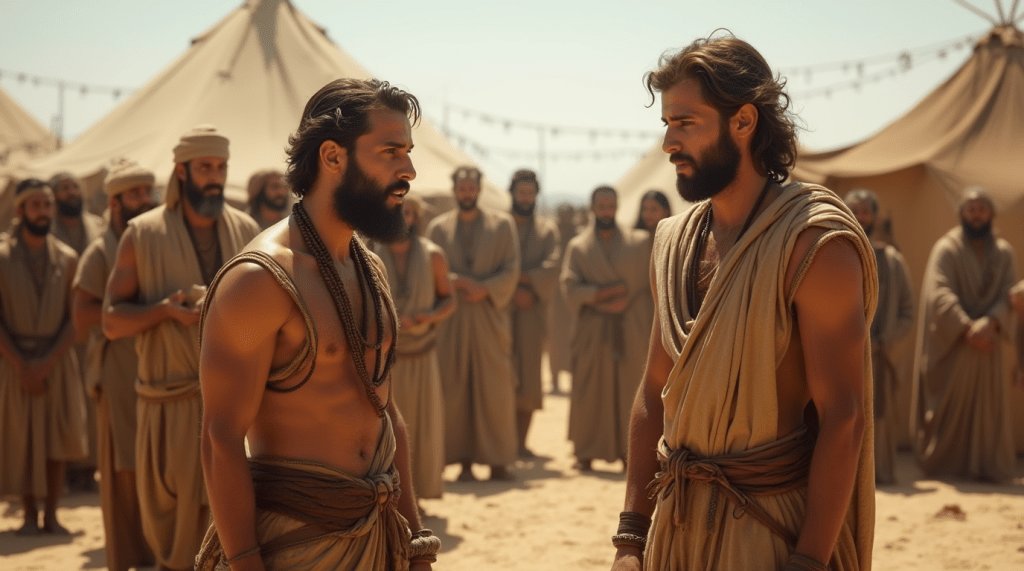
After God had established the newly independent nation of Israel in basic standards of living and worship, He wanted to bring them into the land that He had promised to their ancestor Abraham hundreds of years earlier. But there was a 40-year delay. Why?
The story starts in Numbers 13. One spy from each tribe (their names are given) were sent to Canaan to bring back a report. They came back and reported both rich and fertile land (unlike the desert area of Israel today), but also heavily fortified cities and giant men. There were two very different responses to this:
Then Caleb quieted the people before Moses, and said, “Let us go up at once and take possession, for we are well able to overcome it.”
But the men who had gone up with him said, “We are not able to go up against the people, for they are stronger than we.” And they gave the children of Israel a bad report of the land which they had spied out, saying, “The land through which we have gone as spies is a land that devours its inhabitants, and all the people whom we saw in it are men of great stature. There we saw the giants (the descendants of Anak came from the giants); and we were like grasshoppers in our own sight, and so we were in their sight.” Numbers 13:30-33
Huh… Caleb says “we are able”, and the others say “we are not able”. Why the difference? The next chapter gives us the answer. While the people were crying in hopelessness, Caleb of Judah, and Joshua of Benjamin, spoke to the people:
“they spoke to all the congregation of the children of Israel, saying: “The land we passed through to spy out is an exceedingly good land. If the Lord delights in us, then He will bring us into this land and give it to us, ‘a land which flows with milk and honey.’ Only do not rebel against the Lord, nor fear the people of the land, for they are our bread; their protection has departed from them, and the Lord is with us. Do not fear them.” Numbers 14:7-9
- If something is God’s will, He will “bring us” through and “give it to us”
- Don’t rebel against the blessing that God wants to give
- “If God is for us, who can be against us?” Romans 8:31
Side note: I find it fascinating that hundreds of years later, after the kingdom of Solomon split between Rehoboam and Jeroboam, Judah and Benjamin (Caleb and Joshua’s tribes) stayed together, while the other ten tribes formed the “northern kingdom”. In another few hundred years, Assyria conquered the northern kingdom, but Judah and Benjamin were protected. While all 12 tribes fell into idolatry repeatedly, Judah and Benjamin reformed back to God more often and were less wicked than the ten tribes of Israel. Babylon eventually conquered Jerusalem, because of their rejection of God, but they were allowed to come back and rebuild 70 years later, unlike the ten northern tribes.
The Reaction
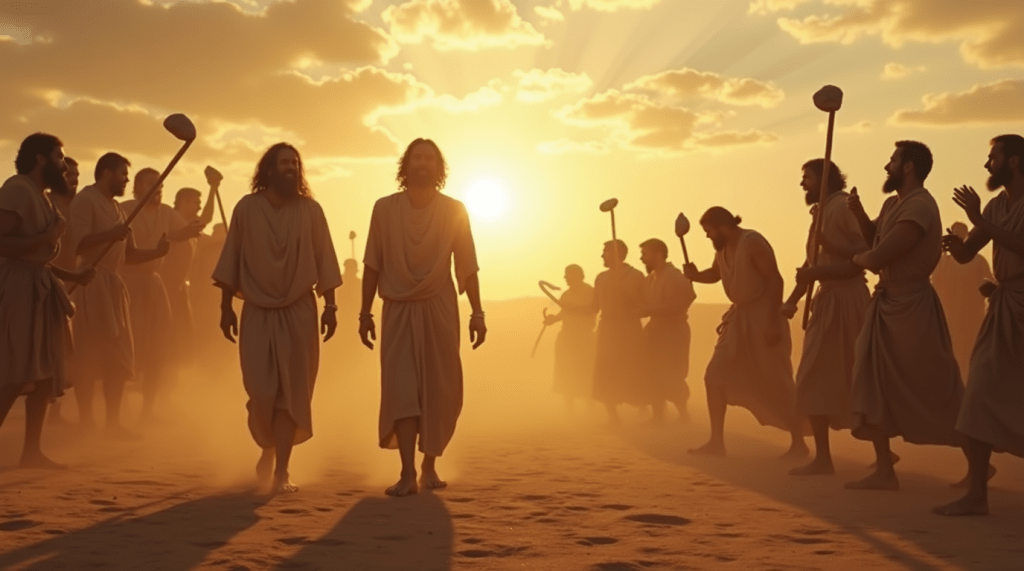
What was the response of the people after Joshua and Caleb tried to encourage them? After they said God’s blessing and protection of the Canaanites had “departed from them” (see Genesis 15:16)? After they said God was with them and would “bring them in”?
First of all, Joshua and Caleb spoke to the people this way because in the first few verses of Numbers 14, the people were ready to rebel against Moses, select their own leader, and return to Egypt.
Second, once these two men tried to step in for Moses and Aaron (who had fallen on their faces) and encourage the people, the people were about to stone them to death!
“And all the congregation said to stone them with stones. Now the glory of the Lord appeared in the tabernacle of meeting before all the children of Israel.” Numbers 14:10
This is amazing. When Joshua and Caleb were about to be stoned, God showed up in person to put a stop to it. He was very angry with the people, and rightly so. All these people had seen with their own eyes:
- Ten deadly, supernatural plagues which devastated the nation which had enslaved them
- The Red Sea parted and pharaoh’s entire army swallowed up
- Manna falling from heaven in a desert where there was no food for 2 million people.
- Bitter waters made sweet
- Water gushing out of a rock
- God giving them victory when the Amalekites attacked them
- God descending on Mount Sinai in thunder, fire, and smoke
And yet they said “we are not able” because lack of faith in God. But they were right about one thing. Even Jesus said, “I can do nothing of Myself” (John 5:30). Yes, Jesus is God, but at that time, His nature was like us humans. We NEED God if we are going to accomplish anything or go anywhere meaningful.
The serpent/dragon Satan had not stopped inspiring distrust in God after the Garden of Eden. His insinuations that God is holding you back, keeping good things from you, keeping you from knowledge and enlightenment, He doesn’t have your best interests at heart, were ringing in their ears 2,500 years later.
“Then the Lord said to Moses: “How long will these people reject Me? And how long will they not believe Me, with all the signs which I have performed among them?” Numbers 14:11
Reasoning with God
To summarize the rest of the chapter, God told Moses He could make a mightier nation out of Moses’ descendants and dispense with these rebels. But Moses pleaded with God for the lives of the people reasoning that Egypt and all the other nations would say God was not able to keep His promise and killed His own people in the wilderness. And how would that look for God’s reputation?
God responded that He would not destroy them immediately, but that they would never go in and settle in the land He had promised, except for Caleb and Joshua. The rest of them would die in the wilderness over the next 40 years.
This was not the only time God reasoned with Moses like a pagan god (I could wipe out these rebels and start over), and Moses appears to change God’s mind. It echoes back to Abraham reasoning with God about Sodom and Gomorrah, and God listening and accommodating him.
But let’s be clear, these men are not dissuading God from doing something He wants to do. Instead, God is testing and displaying their characters in the same way He did with Job (Job chapters 1 & 2).
- Satan: “Job only follows You because You bless and protect him. If some tragedies hit him, he’ll curse You.”
- God: “Seems like proof is required. You can persecute him but only within the limits I give you. You can’t kill him.”
And just like God knew he would, Moses started pleading that God would have mercy once again and forgive the people. He could have agreed with God, and said “good idea, destroy them and make a nation out of my descendants”. But he didn’t. And to be clear, God could have wiped out all but Moses’ family and still kept His promise to Abraham.
In Exodus 32:32, after the golden calf incident, God threatened to destroy the people, and Moses offered to have his own name blotted out of the Book of Life, if God would spare them. This is almost unbelievable, because if God were to take Moses up on this, Moses would die forever, and never be taken to Heaven, or live in the New Earth that God promised to recreate. How selfless!
This reasoning between God and the patriarchs (Abraham, Moses) was not for their benefit, or to help God make up His mind. It was for us reading this 3,500 years later. It was for holy angels. It was for unfallen worlds elsewhere in God’s Universe to witness.
Satan (“satan” in Hebrew means “accuser”) is saying, “Look! The humans are doing all these nasty, despicable, horrible things! You can’t save them, God! If You did, You’d have to save me too.”
So God responds, “No. Look again. There are still people who share My mercy and love and unselfishness. There are still people who strive to follow My ways of peace, generosity, and kindness. There are still people who suffer patiently and forgive those who reject and betray them. Those people, I CAN and WILL save!”
Always the Opposite Direction
What happened next is a real head scratcher:
- God says: I’m going to fulfill My promise to your forefather Abraham, and bring you into a beautiful, fertile land
- They say: NO! Cities too strong, giants too big.
- God says: Fine, you don’t trust Me to take care of you? You will not go in.
- They say: Oh yeah? Watch this! We’re going in.
They march into the mountains, despite Moses’ warnings, and promptly get beaten and routed by the Amalekites and Canaanites, who chased them all the way back to Hormah. They could have gone with God leading and won, but instead, they failed without Him.
Promised Land & the Sabbath

Once you’ve digested Numbers 13 & 14, now you have a framework to understand Hebrews 3 and 4, where the writer is pointing to this very story. The writer then compares the stubborn Israelites who refused God’s promises and blessings to the people who refuse to to enter the “rest” God offers. In Hebrews 4:4 this “rest” is connected to the seventh day and God resting from His work at Creation.
“There remains therefore a rest for the people of God.” Hebrews 4:9
The Sabbath was never reconfirmed in New Testament? It was done away with? Not important anymore? That’s not what the Bible actually says. In fact, Hebrews 4 verses 6 and 11, both say if we do not enter this rest connected to the seventh day and Creation, we do so from “disobedience”. Just like the Israelites refusing to enter Canaan, we would be rejecting a blessing God wants us to have.
The Israelites and Modern Christians
We’re in the same boat now. God led the Israelites out of bondage in Egypt to the borders of the Promised Land. Now we are on the border of Jesus’ second coming when He will bring His children out of this sinful, fallen world. Satan and his fallen angels are throwing intimidations and threats at us as a last ditch effort, just like the pharaoh chasing down the Israelites with his army and chariots.
We can only overcome fear through knowing and trusting God. He’s bigger, stronger, and more powerful, AND He loves us. We can also trust that if we have faith in Jesus…
“He who overcomes shall not be hurt by the second death.” Revelation 2:11
In Revelation, Jesus was speaking to the churches after He had ascended to Heaven, but in these next two verses Jesus expresses the same thing during His earthly ministry before He was glorified.
“Jesus said to her, “I am the resurrection and the life. He who believes in Me, though he may die, he shall live. And whoever lives and believes in Me shall never die.” John 11:25-26
“And do not fear those who kill the body but cannot kill the soul. But rather fear Him who is able to destroy both soul and body in hell.” Matthew 10:28
There’s a lot of truths touched on in these few words, but basically, we don’t need to be afraid of what happens now, because even if we die, Jesus will resurrect us to new life when He returns. Don’t fear men, but respect God. Why?
Humans can kill you so the first death happens prematurely (you were going to die this death anyway, Hebrews 9:27). But God is the one who brings about the “second death” of Revelation 20 & 21, and there is no resurrection from this death – it is permanent destruction of soul and body.
Bottom line: When we step back and look at things from an eternal perspective, we don’t need to be afraid of the giants and impossible odds we face in this world. If we trust God, He will bring us into the land He has promised – Heaven, and eventually a re-created Earth.

 God's Work with Planet Earth
Leave a comment