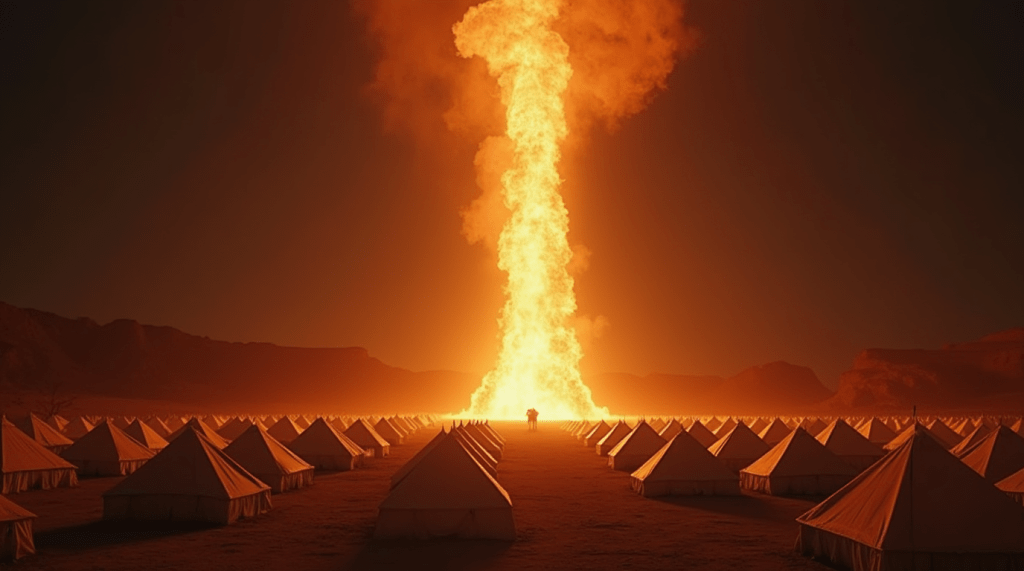
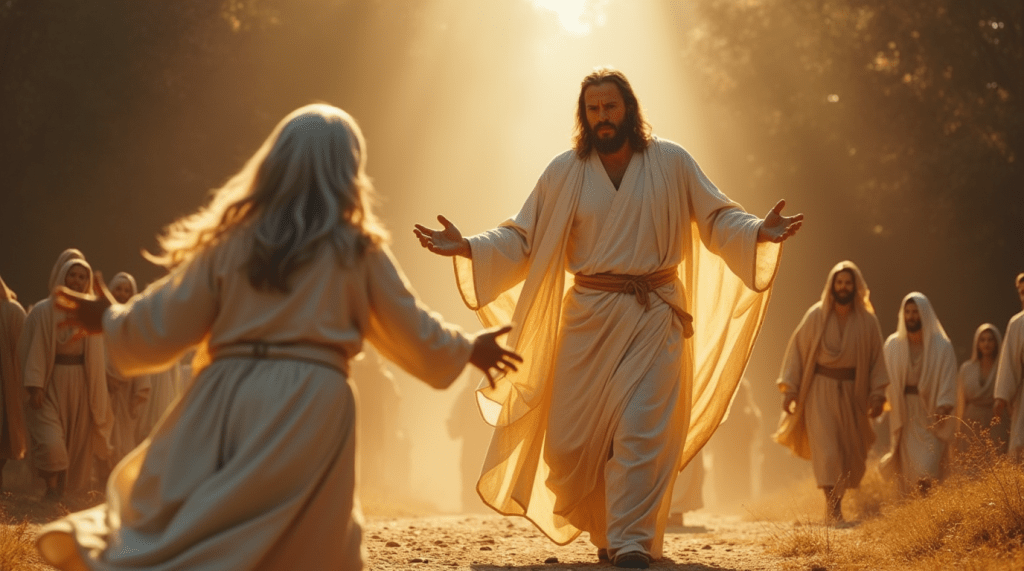
There are a lot of parallels between The Exodus and Jesus’ Second Coming, but there is one difference that I find interesting. The Israelites wandered in the desert for 40 years, and during that time they went through what we might call today “growth opportunities”. However, there is no indication in Revelation or elsewhere in the Bible that God’s people will enter a wilderness wandering or some kind of refining purgatory after Jesus returns. Jesus said,
“I will come again and receive you to Myself; that where I am, there you may be also.” John 14:3
If we take a look at the two verses before, we see that “where I am” or where Jesus was going was “My Father’s house” or Heaven. And the Apostle Paul wrote:
“And the dead in Christ will rise first. Then we who are alive and remain shall be caught up together with them in the clouds to meet the Lord in the air. And thus we shall always be with the Lord.” 1 Thessalonians 4:16-17
God’s people will be taken to Heaven when Jesus returns – no wilderness wandering. Does that mean we don’t have to go through that experience? You and I are in it right now. We live in a sinful world and this is our wilderness. My mother was killed by a drunk driver when I was five years old and my little brother was four. My dad was instantly a single dad. I had to battle cancer during ages 8, 9 and 10. These are faith-shaking experiences. What is the purpose of the difficulties and trials we endure in this life? Peter summed it up quite well, and you really need to read all of this:
“…now for a little while, if need be, you have been grieved by various trials, that the genuineness of your faith, being much more precious than gold that perishes, though it is tested by fire, may be found to praise, honor, and glory at the revelation of Jesus Christ, whom having not seen you love. Though now you do not see Him, yet believing, you rejoice with joy inexpressible and full of glory, receiving the end of your faith—the salvation of your souls.” 1 Peter 1:6-9
- “a little while” is my whole earthly life? Well, what’s 80 years compared to eternity?
- Our character and our faith is like gold being refined in a fire
- “the end of your faith”? When Jesus shows up, do you need faith any longer? Also, “the end” can mean the ultimate result, and the end (outcome) of faith is salvation, according to the Bible
- “But he who endures to the end shall be saved.” Matthew 24:13
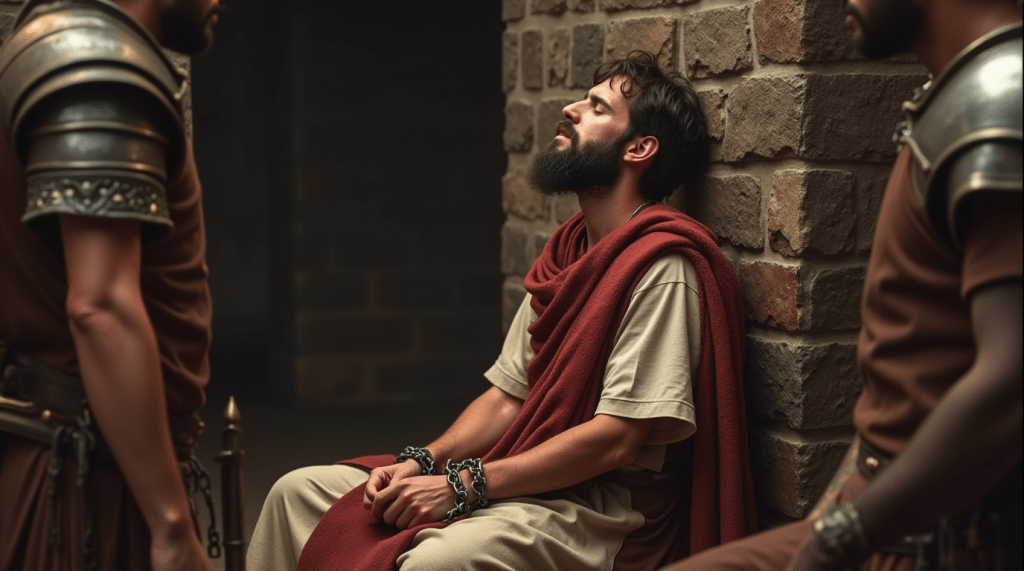
So how did God do this with the Israelites? In Egypt, they went through persecution under a pagan oppressor, who was also a bad influence on them. So they had to relearn some things their ancestors Abraham, Isaac, and Jacob knew. Also, speaking of the Israelites in the wilderness, Paul wrote:
“Now all these things happened to them as examples, and they were written for our admonition, upon whom the ends of the ages have come.” 1 Corinthians 10:11
Since our focus in this blog series is getting to know God by the things He does, we’ll focus on that here.
God the Provider
I lost my job a few years ago, and with a mortgage and wife and kids, I shared my concern with my brother about finding another job and being able to provide for my family. My brother was blunt, but he told me what I needed to hear. “Oh, you think you’re the provider for your family? You’re not. You’re just a conduit for God’s blessings to them.” He was right, and I learned to trust God more from that experience because He worked everything out in an amazing way.
“…Bread will be given him, his water will be sure.” Isaiah 33:16
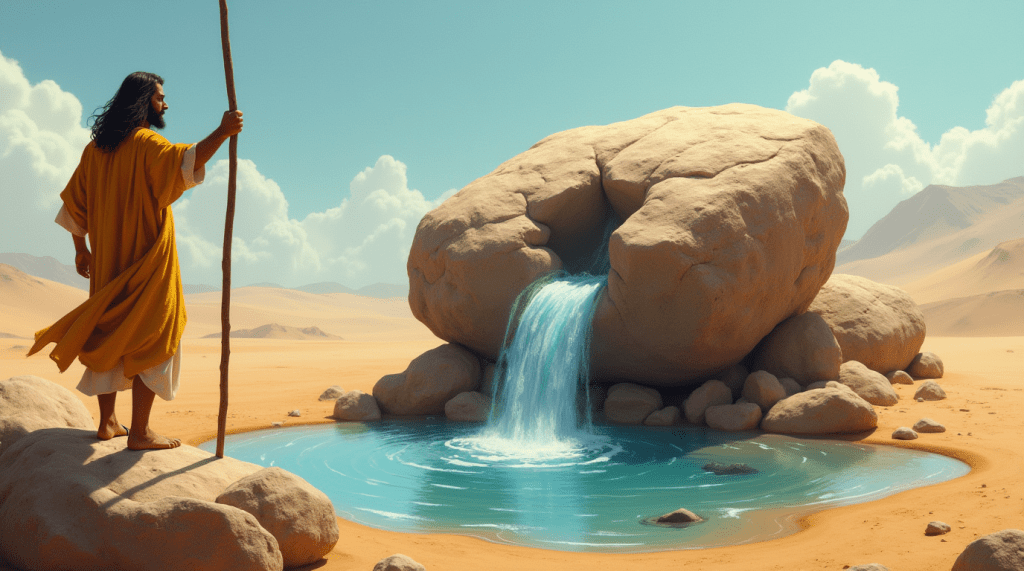
God brought water gushing out of a rock in Exodus 17:6. He made “manna” appear with the dew to feed them in Exodus 16. He was sustaining them and meeting their basic, physical needs, the entire 40 years in the wilderness.
Paul makes a spiritual comparison with their experience:
“…all our fathers were under the cloud, all passed through the sea, all were baptized into Moses in the cloud and in the sea, all ate the same spiritual food, and all drank the same spiritual drink. For they drank of that spiritual Rock that followed them, and that Rock was Christ.” 1 Corinthians 10:1-4
Paul is expanding on what Jesus said:
“Jesus answered, “Most assuredly, I say to you, unless one is born of water and the Spirit, he cannot enter the kingdom of God.” John 3:5
But Paul also emphasizes that the One who passed through the wilderness with them was Christ.
Serpent on a Pole
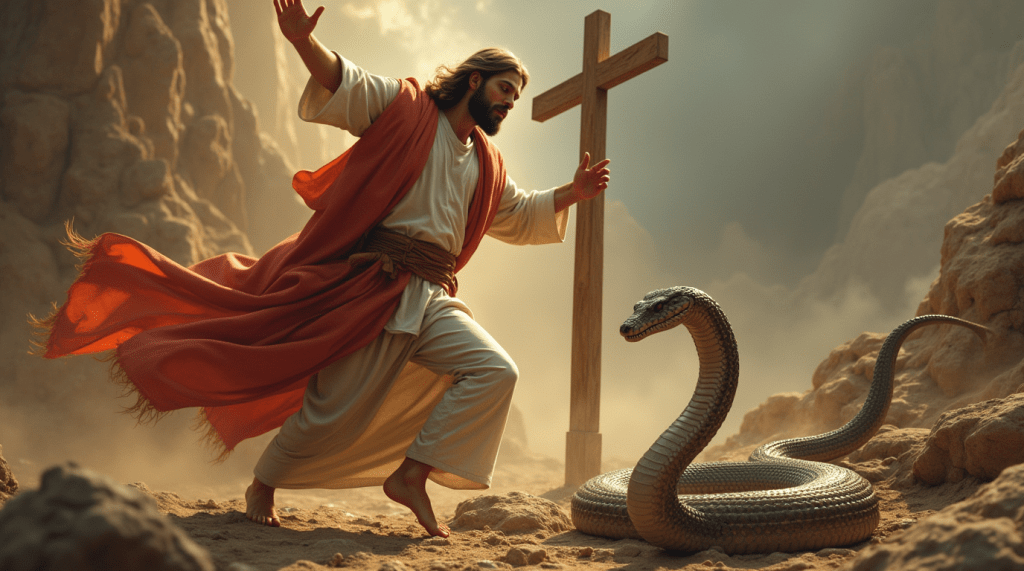
In spite of having their food and water provided, there was a lot of complaining about not having meat and fish as they did in Egypt, as well as complaining about other things. At one point (Numbers 21:4-9) they complained so bitterly that God removed His protection, allowing desert vipers to come into the camp and bite people.
Many people were dying. They went to Moses, admitting that they were wrong to complain against God, asking that the snakes be removed from their camp. God told Moses to make a serpent from bronze and put it on a pole, and tell the people to look at it. Whoever was bitten and looked at it lived.
First question, why does a serpent on a pole represent Jesus on the cross? Here’s the answer:
“He made Him who knew no sin to be sin for us, that we might become the righteousness of God in Him.” 2 Corinthians 5:21
Think about the serpent in the garden, tempting Eve, bringing sin into the world. Jesus Christ took all of the guilt of our sins on Himself to provide a way out for us. This is the only way He could get us out from under “the wages of sin is death” Romans 6:23). Jesus “became sin for us”, which is why the symbol of sin, the serpent, was used by God to heal the people of snake bites long before Christ was born as a human, Jesus.
The Biblical requirement for salvation is faith in Jesus. We’ve all been bitten by sin, and it’s a curse of death. But if we keep our eyes on Jesus, and we don’t let the temptations and harassments of the Devil lead us away, we will be saved.
Moses Challenged
There were multiple times Moses’ leadership was challenged, and each time God stepped in to reconfirm to the people that He had chosen Moses. One of them may indicate early racism, which made me curious. Numbers 12:1 tells us Aaron and Miriam, Moses’ older siblings were questioning his authority because he had married a “kushiyth” (Cushite) woman.
Moses met his wife, Zipporah, in the land of Midian after he fled Egypt at 40 years of age. Midian was a son of Abraham through Keturah, and Abraham was a descendant of Noah’s son Shem. However, Cush was a son of Noah’s son Ham, and his descendants later settled in Ethiopia. So basically Zipporah’s family were descendants of Ham, but living in a territory of descendants of Shem. The animosity between these two groups likely started from Genesis 9:20-27 (you can go read that if you’re curious). God’s people are imperfect, God is not.
In any case, God explained that He gave prophets dreams and visions, but to Moses He spoke verbally, directly, and plainly (Numbers 12:6-8). He gave Miriam leprosy for a very short time to show them how serious this was. They wanted their brother’s position, but that was not the role God had placed them in. Do we ever reach for something we want, but it’s outside of God’s will for us? Do we ever get “too big for our britches”, as the expression goes?
God with Us
The instructions to build the tabernacle were extremely detailed. Hebrews 8:5 clues us in that this tabernacle was a model of the real heavenly sanctuary. It was also meant to illustrate God’s plan of salvation (Psalms 77:13), and each piece has a special meaning.
But here’s the very simple thing that amazes me:
“But will God indeed dwell on the earth? Behold, heaven and the heaven of heavens cannot contain You. How much less this temple which I have built!” 1 Kings 8:27
“the Most High does not dwell in temples made with hands” Acts 7:48
And yet this is what God did to be near us:
“And let them make Me a sanctuary, that I may dwell among them.” Exodus 25:8
When everything is said and done, after this world ends, and sin is ended, God’s ultimate plan involves this:
“Now I saw a new heaven and a new earth, for the first heaven and the first earth had passed away. Also there was no more sea. Then I, John, saw the holy city, New Jerusalem, coming down out of heaven from God, prepared as a bride adorned for her husband. And I heard a loud voice from heaven saying, “Behold, the tabernacle of God is with men, and He will dwell with them, and they shall be His people. God Himself will be with them and be their God.” Revelation 21:1-3
This is the reason for all of God’s patience, “longsuffering”, and mercy. Jesus “endured the cross” “for the joy that was before Him” (Hebrews 12:2), knowing that He would be reunited with His people one day, and we’ll no longer be separated. God’s future plans and intent for the New Earth (which is still in our future) show up in the tabernacle with the Israelites in the wilderness.


 God's Work with Planet Earth
Leave a comment