
Anti-Christian liberals say God and Christianity are responsible for an “oppressive patriarchy” that keeps women subservient and controlled by men. If that’s true, it’s very unfair and unjust to women, and very sexist. But is it true?
Right now in this blog series, we’re in Stage 2 (out of 5) of God’s Work with Planet Earth, and we’re entering the period of the judges which is followed by the period of the kings. But I need to reach back into Stage 1, and forward into Stage 3 and 4 (in addition to examples from Stage 2), to see what God intended for women and how He sees them.
“Male and Female He Created Them”

The Bible can seem to favor men because all the authors are men, and humanity is called “men”, when it is actually referring to all human beings. But except for Hebrew scholars, most of us are unaware that the Hebrew language has both masculine and feminine forms of words, even for inanimate things and objects. So there’s far more going on than just favoring men. But in the very beginning:
“So God created man in His own image; in the image of God He created him; male and female He created them.” Genesis 1:27
An image is not a duplicate or an exact copy, and it is not the thing itself. It is a reflection with similarities, and which resembles the original. What an honor for “man” (human beings) to be created with features and traits like our Creator!
Notice that both men and women had this honor of being made in the image of God. This is consistent with Eve being created from Adam’s rib rather than a toenail or a hair, to show that she was an equal partner with him. Women have different strengths, features, and qualities from men, but they were made in God’s image just like men. God did not intend for women to be trampled on or ruled over by men, and He did not intend that women should rule over men.
Instead, men and women were created to complement and help each other. The Hebrew word “ezer” (helper) means aid or help. When we help or assist someone, do we think of ourselves as being subservient to them? No, we simply enjoy making someone else’s life better.
“And the LORD God said, “It is not good that man should be alone; I will make him a helper comparable to him.” Genesis 2:18
None of this suggests that God intended women to be enslaved or dominated by men. But this was God’s original plan before sin entered the world. Now we often do see people of all types treated unfairly, harshly, unjustly, including women.
An Example from Moses
“When a man has taken a new wife, he shall not go out to war or be charged with any business; he shall be free at home one year, and bring happiness to his wife whom he has taken.” Deuteronomy 24:5
The purpose is so the man can “bring happiness to his wife”. What about the man’s happiness? It might be assumed or implied, but it’s not mentioned here.
In verses 1-4 is a law about divorce. After the Israelites were delivered from Egypt, sometimes men would get tired of their wives and send them out of their household. Moses, guided by God, basically said, “No, you can’t just kick your wife to the street for any reason. You need a valid reason like sexual immorality or idolatry. And then you need to give her a certificate stating why you are divorcing her.”
Who is this law protecting from unjust treatment? The woman. The wife.
Jesus confirmed this in Matthew 5:31-32, though in Matthew 19:7-9 He says divorce was only allowed because of the hardness of people’s hearts. God’s ideal is: There should be no broken promises.
An Example from the Judges
“Now Deborah, a prophetess, the wife of Lapidoth, was judging Israel at that time. And she would sit under the palm tree of Deborah between Ramah and Bethel in the mountains of Ephraim. And the children of Israel came up to her for judgment.” Judges 4:4-5
The period of the judges, between the Exodus and the first kings, lasted around 400 years. Israel was supposed to be a theocracy, meaning a nation ruled by God rather than human monarchs. God spoke through prophets, and evidently, prophetesses.
During Deborah’s time, if you were from one of the 12 tribes of Israel, and you wanted to know God’s will for a certain situation, you would go talk with the lady under the big palm tree between Ramah and Bethel. This is important to understand, because even the leaders of tribes and families who were men were going to Deborah for advice and to hear God’s messages spoken through her. Does this sound chauvinistic? Does it sound like God is excluding women by refusing to speak through them?
The real reason for this dynamic is that Deborah submitted to the Spirit of God and dedicated her life to passing on His messages to His people. Neither men or women should expect that God will use them in leadership according to His purposes without this commitment and sacrifice.

An Example from the Kings
“So Hilkiah the priest, Ahikam, Achbor, Shaphan, and Asaiah went to Huldah the prophetess, the wife of Shallum the son of Tikvah, the son of Harhas, keeper of the wardrobe. (She dwelt in Jerusalem in the Second Quarter.) And they spoke with her.” 2 Kings 22:14
Backstory: Solomon’s Temple had been neglected because most people had forgotten God. The kingdom of Judah had kings who led the people into idolatry against God’s commands, and some kings who reformed and tried to stamp out the idolatry and pagan forms of worship.
King Josiah came to the throne in 634 BC. While still quite young, at 26 years old, he ordered his officials to clean up the Temple to bring back the worship of God. In the process, they found the book of the law (a book or the books of Moses), and when they read it to the king, he tore his clothes because he recognized how far they had fallen from what God intended for His people.
Then he sent a priest and four leading men of Judah to go find the prophetess Huldah to ask God what they should do. The highest officials in the nation, who worked for the king, inquiring of a woman. Well, she was so close to God, they knew He was speaking through her. It didn’t matter that she was a woman.
The Four Women in Jesus’ Genealogy
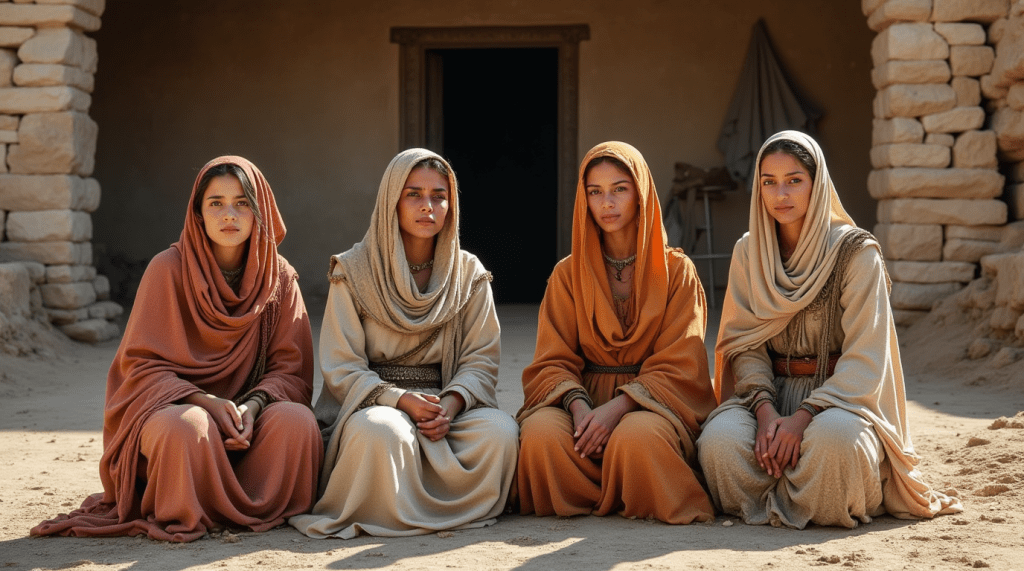
This gets REALLY interesting. Matthew only mentioned four women in his listing of Jesus’ ancestors. He traces every generation all the way back to Abraham, to show that Jesus descended from both Abraham and David, and so He matched up with many Old Testament messianic prophecies and God’s promises to Eve (Genesis 3:15) and Abraham (Genesis 12 & 13). But why include only four of the mothers across 42 generations? Why these women, specifically?
We can read about these women in the Old Testament, so at least we know a little about them.
Tamar – An Aramean Gentile. Genesis 38 is a story of Judah’s badly dysfunctional family (remember, Judah was a great grandson of Abraham). Tamar was Judah’s daughter-in-law. Long story short: After being sent back to her father’s house by Judah after two of Judah’s sons died, she disguised herself as a prostitute, tricked her father-in-law into sleeping with her and giving her twins (Perez and Zerah, they’re both mentioned in Matthew 1). In this way, she became the mother of most of the tribe of Judah.
Rahab – A Canaanite of Jericho. Rahab sheltered the Israelite spies before they took Jericho. Joshua 2 describes her as a harlot, but she had faith in Israel’s God (verses 8-13) and she was saved from the destruction of the city. She married a man from the tribe of Judah named Salmon. So Rahab ended up being King David’s great-great grandmother.
Ruth – A Moabite. In the Book of Ruth, Elimilech and Naomi, again from the tribe of Judah, went to live in Moab during a famine in Israel. Their sons married Moabite women. After Elimilech and his two sons tragically died, Orpah stayed in her home country and Ruth followed her mother-in-law Naomi back to Bethlehem. Ruth married Boaz (the son of Salmon and Rahab).
Bathsheba – Married to a Hittite. It is unclear from 2 Samuel 11 just how consensual her adultery with King David was. We only know that David saw her bathing from his palace roof, lusted after her, sent messengers to bring her to him, and they slept together – all while her husband Uriah was off fighting battles for David. David and Bathsheba’s first child died, but they later had Solomon, who succeeded David as king over the 12 tribes. Solomon is also listed as an ancestor of Jesus.
Matthew is not advocating for women by including them in Jesus family tree, because these are not just women – only Bathsheba was a Jew. They were Gentiles, and not just Gentiles, but mixed up in sexual immorality in every case except for Ruth. The Jews in Jesus’ time would look down on them as the lowest of society. Yet they were part of the family line God used for Christ to be born as the human Jesus.
What’s the Takeaway?
What lesson do we take from this? These ladies (except Bathsheba) were Gentiles who got “grafted into” God’s people (Romans 11:13-24) even before Jesus came. There’s some pretty twisted stories in the lives of people who got caught up in sin in one way or another, but God used these family members to bring the Savior of the world. Just think what He could do with your life!
“And we know that all things work together for good to those who love God, to those who are the called according to His purpose.” Romans 8:28
This says God can use “all things”, even the bad things, for His purpose in our lives.
So God is not a misogynist or a woman hater (He’s the woman Creator), but He’s not a racist either.
“There is neither Jew nor Greek, there is neither slave nor free, there is neither male nor female; for you are all one in Christ Jesus.” Galatians 3:28
“For there is no partiality with God.” Romans 2:11
God doesn’t have favorites, He loves all of us humans He created and wants to save all of us (2 Peter 3:9). We know He hates sin, but He loves sinners enough to give His own Son to save them from sin.
“But God demonstrates His own love toward us, in that while we were still sinners, Christ died for us.” Romans 5:8



 God's Work with Planet Earth
Leave a comment