“So he answered and said to me: “This is the word of the Lord to Zerubbabel: ‘Not by might nor by power, but by My Spirit,’ says the Lord of hosts.” Zechariah 4:6
Zerubbabel was a descendant of King David, and the governor of Judah under the Persian empire around the time the Jews were allowed to rebuild Jerusalem and the temple, both of which the Babylonians had destroyed. But though this verse was inspired over 700 years after the time of Gideon, it fits his story very well.
Gideon meets Christ
The lead-up to Gideon starts in Judges 6. Over and over during the period of the Judges and the period of the Kings, the Israelites disobeyed God, and this was just one of those times.
“Then the children of Israel did evil in the sight of the Lord. So the Lord delivered them into the hand of Midian for seven years.” Judges 6:1
The verses which come after inform us that the Midianites overran the Israelites, to the point that they were hiding in caves and mountain strongholds. Any crops or livestock they raised were not just taken by the Midianites, but destroyed, so they became “greatly impoverished”. God took away His blessing and protection when they started worshiping false gods and sinning (breaking His commandments).
So the people started crying out to God, asking for deliverance. In verse 10, God told them through a prophet that He had told them not to fear or worship the gods of the Amorites, “but you have not obeyed My voice.” But because they were calling to Him for help once again, He raised up a deliverer, named Gideon.
“And the Angel of the LORD appeared to him, and said to him, “The LORD is with you, you mighty man of valor!” Judges 6:12
Why do I think this was Christ who met Gideon?
- When “LORD” shows up in all caps, that’s the tetragrammaton in Hebrew, or YHWH, or Yahweh (sometimes Jehovah).
- The phrase “the angel of the LORD” can be translated “the LORD in the form of an angel”.
- The disciples called Jesus (Christ incarnate) “Lord” (Greek “kurios”) in the New Testament.
- When Gideon realized Who he had seen, he was afraid he would die (and with good reason, see Exodus 33:20). The “LORD” assured him that he would not die.
Isn’t that awesome, that the first words to Gideon are those of encouragement and assuring him that “the LORD is with you”. Gideon probably didn’t feel like a “mighty man of valor”, hiding his grain threshing in a winepress so the Midianites would not destroy it. But Christ sees in us our potential, and what we can be with His guidance and power, rather than our current failings.
Testing Each Other, Building Trust
Once Gideon met God (Christ appearing like an angel), a series of tests began. I always focused on Gideon’s desire to see signs from God, but when I really look at Judges 6 and 7 carefully, God was testing him at the same time.
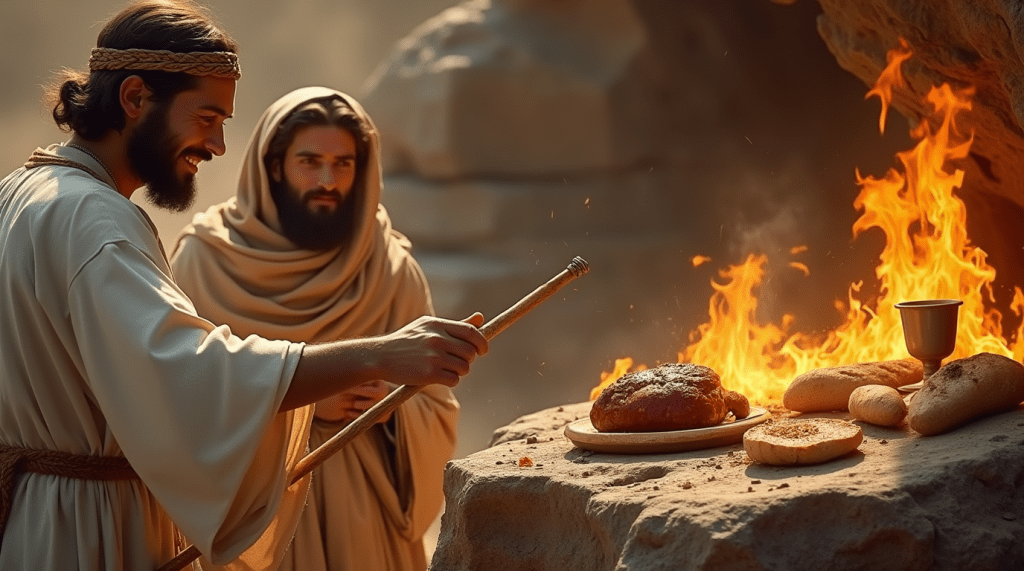
First Test: The words “show me a sign” first show up in verse 17. Gideon went and got meat, bread, and broth, and put them on a rock. Christ touched them with a rod and fire came out of the rock and consumed the food.
Second Test: Now it’s God’s turn to test Gideon. He is given instructions to take a specific bull, “the second bull of seven years old”, tear down the altar to Baal, and cut down the wooden pole. While it doesn’t say so in this chapter, the wooden pole was an idol to the Canaanite fertility goddess, Asherah. The first two of the Ten Commandments forbid setting something like this up and worshipping another god.
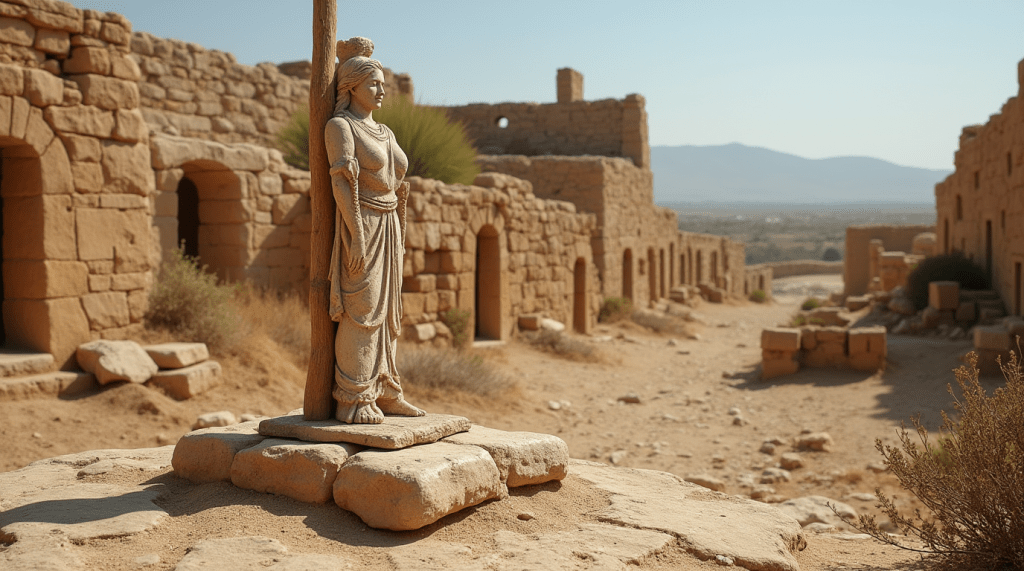
Why is this a test? The altar and idol belonged to Gideon’s father, Joash, and they were known in the neighborhood. Gideon took ten men to destroy them, but he was still afraid of the neighbors, so he did it at night. So it was a test of Gideon’s commitment to go against his father and the whole city.
God also told him to replace the pagan altar with an altar to God. This is an outward, literal, physical sign of a shift in spiritual loyalty and worship. The fallen angels see it, the holy angels see it, the humans see it, so everyone knows what’s going on. Destroy the altar and idol to false gods, build a new altar to the true God. Notice no idol to God, because He commanded against ANY idols or images, even to Himself.
Gideon’s fear of “the men of the city” was well founded, because when they woke up the next morning and saw what he had done, they wanted to kill him. They demanded that Joash hand over his son. I love Joash’s response. He basically said, “Does the god really need you to defend him? If Baal is really a god, he’s powerful enough to avenge himself! Anyone who thinks otherwise should die.”
Third Test: Now it’s Gideon’s turn to test God. The Midianites and Amalekites invaded and camped in the Jezreel Valley, which was also called the Valley of Megiddo in other places in the Bible. Judges 1:27 says that Manasseh (Gideon’s tribe) did not drive the Canaanites out of this valley as God had commanded.
So Gideon, inspired by God’s Spirit, called up the tribes of Mannaseh, Asher, Zebulon, Naphtali, gathering them for war against the Midianites. But he was still uncertain and afraid, and he wanted more assurance from God.
Gideon knew his place and he was not proud. He knew only God could do through him what God was telling him to accomplish. He knew they were severely outnumbered by the enemy. Doing a little math with Judges 8:10 tells us he was up against a combined army of 135,000 enemy warriors.
“So he said to Him, “O my Lord, how can I save Israel? Indeed my clan is the weakest in Manasseh, and I am the least in my father’s house.” Judges 6:15
This was his first request:
“look, I shall put a fleece of wool on the threshing floor; if there is dew on the fleece only, and it is dry on all the ground, then I shall know that You will save Israel by my hand, as You have said.” Judges 6:37
Sure enough, the next morning, wet fleece, dry ground. But Gideon may have thought twice. Fleece absorbs moisture. So he humbly asked for the reverse: wet ground, dry fleece. And it happened. All the ground was wet with dew, but the fleece was dry.
Fourth Test: God had chosen the least important man of the weakest family of the second smallest of all the tribes of Israel, just to prove that…
“…My strength is made perfect in weakness.” 2 Corinthians 12:9
But now God takes it to a whole other level!
“And the Lord said to Gideon, “The people who are with you are too many for Me to give the Midianites into their hands, lest Israel claim glory for itself against Me, saying, ‘My own hand has saved me.’” Judges 7:2
God told Gideon that whoever was “fearful and afraid”, they could go home. And Gideon watched his meagerly army of 32,000 shrink to 10,000. Surely the people would know that God won the battle for them with only 10,000 against 135,000 enemies, right?
“But the Lord said to Gideon, “The people are still too many; bring them down to the water, and I will test them for you there.” Judges 7:4
Interesting… So God is not only testing Gideon, but also testing and selecting the men who will fight under him. When the 10,000 came to a river, most of them got down on their bellies and sucked up the water with their mouths. Only 300 of them waded in and scooped up the water in their hands, eyes still scanning their surroundings. God told Gideon to let everyone else go home.

The Final Sign
God reduced Gideon’s army from 32,000 to 300, and Gideon still trusted Him. God was understanding that He was really testing Gideon’s faith, so He sent Gideon on a spy mission into the enemy camp. He could have said “I’ve already given you signs, don’t be a wimp!” But instead, before Gideon even voiced his misgivings, God generously gave him another sign.
“But if you are afraid to go down, go down to the camp with Purah your servant, and you shall hear what they say; and afterward your hands shall be strengthened to go down against the camp.” Judges 7:10-11
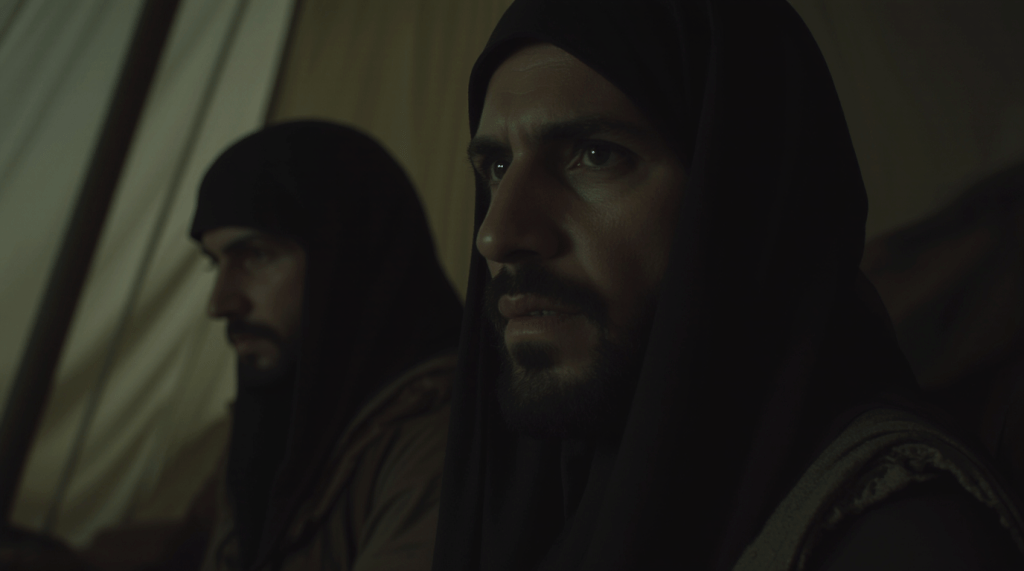
As Gideon and his servant were creeping up to the enemy tents in the darkness, he overheard one Midianite soldier telling his dream to another.
In the strange dream, a loaf of bread came rolling down the hill into the Midianite camp, struck a tent, and knocked it over upside down.
“Then his companion answered and said, “This is nothing else but the sword of Gideon the son of Joash, a man of Israel! Into his hand God has delivered Midian and the whole camp.” Judges 7:14
After eavesdropping on this conversation, Gideon was encouraged and made plans to attack.
Trumpets and Torches
Taking a trumpet and a torch hidden in an empty water pitcher seems like an odd way to start a battle against an enemy who outnumbers you 450 to 1. But these 300 gathered on three sides of the Midianite camp, broke the clay pitchers to expose the torches (and probably make an awful racket of smashing and clattering across the valley). Then they blew their trumpets.
Usually there’s one trumpet blower for a whole company of soldiers, so you can imagine if 300 trumpets are blown and torches show up all around, how many enemies the Midianites probably thought were surprise attacking them.
But that wasn’t all, because God was there too.
“When the three hundred blew the trumpets, the Lord set every man’s sword against his companion throughout the whole camp; and the army fled…” Judges 7:22
They were so shocked and panicked that they started fighting and killing each other. This isn’t the only time where God confused Israel’s enemies so they killed each other. Other examples are found in 1 Samuel 14, and 2 Chronicles 20.
The Takeaway
Why are stories like this included in the Holy Bible? “For our learning” and so that we can have “patience” (endurance) “comfort” and “hope”. Romans 15:4
Gideon had a physical battle in front of him, but what humans don’t see is the spiritual battle. Baal and Asherah are really fallen angels playing gods and getting people to worship them. I said “are” because they’re still around today. Just as each of the ten plagues of Egypt were targeting a specific god or gods they worshiped, the panic and confusion leading to the Midianites killing each other was brought on by God to prove He was more powerful and could rescue His people when they cried out to Him for help.
But the real battle is between God and His angels and Satan and his angels over the hearts of humans. Who will end up with our trust and loyalty? You can follow the false gods for temporary pleasures or follow the true God for deliverance, reconciliation, and eternal life.
I grew up understanding that God made impossible odds even more impossible for Gideon to show His strength in their weakness. But I just discovered that while Gideon was testing God by asking for signs, God was also testing him by giving specific instructions which tested his faith and commitment. Would he trust God and follow through in obedience? Would we?


 God's Work with Planet Earth
Leave a comment