The time period of the Judges was between 300 to 400 years (there are multiple ways to measure this time period). Gideon, one of the judges, described how Israel was governed during this time period, after he drove out the Midianites who had taken over a large part of Israel.
Then the men of Israel said to Gideon, “Rule over us, both you and your son, and your grandson also; for you have delivered us from the hand of Midian.”
But Gideon said to them, “I will not rule over you, nor shall my son rule over you; the Lord shall rule over you.” Judges 8:22-23
This is called a “theocracy”. God rules and guides the nation instead of a human king or president. Some definitions describe priests who rule and are considered to be divinely guided by God. But that gets very tricky, because how do we know the priest is doing exactly what God tells him, instead of ruling just like a king and using his own human wisdom, and relying on political power?
…in their own eyes.
The last verse in the Book of Judges states:
“In those days there was no king in Israel; everyone did what was right in his own eyes.” Judges 21:25
The last four chapters of the Book of Judges are some of the hardest to read in the whole Bible. Benjamites actually did to a woman what the Sodomites wanted to do to angels (who they thought were men, Genesis 19). This caused a civil war between other tribes of Israel and Benjamin, which resulted in the loss of over 65,000 men on both sides. This was the result of humans following their own wisdom and deciding for themselves what was right instead of relying on God for guidance.
Chapter 20 shows God agreeing that they go to war against Benjamin because they defended murderers and rapists, but most of what we read is humans behaving in an absolutely barbaric manner, doing whatever was right in their own eyes.
…rule over us.
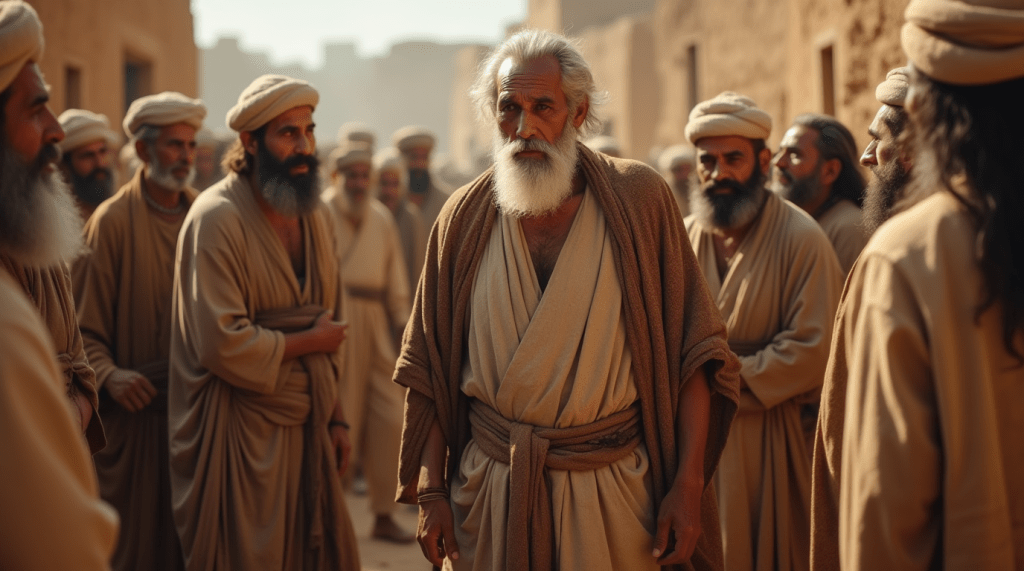
Samuel was the last judge of Israel, and a prophet, just as Moses was. His mother dedicated him to God’s service at a very young age. But when he got old, his sons who could have taken his place became corrupt, “took bribes and perverted justice”. (1 Samuel 8:3)
“Then all the elders of Israel gathered together and came to Samuel at Ramah, and said to him, “Look, you are old, and your sons do not walk in your ways. Now make us a king to judge us like all the nations.” 1 Samuel 8:4-5
There were two factors driving the Israelites’ demanding a king:
- Samuel’s sons were not following in his footsteps and being faithful to God, or shepherding the people as they should
- The Israelites wanted to be like the other nations, who all had kings
Samuel was upset by this, so he prayed to God about it. Isn’t that would you and I should do when people or situations upset and frustrate us?
“And the Lord said to Samuel, “Heed the voice of the people in all that they say to you; for they have not rejected you, but they have rejected Me, that I should not reign over them. According to all the works which they have done since the day that I brought them up out of Egypt, even to this day—with which they have forsaken Me and served other gods—so they are doing to you also. Now therefore, heed their voice. However, you shall solemnly forewarn them, and show them the behavior of the king who will reign over them.” 1 Samuel 8:7-9
I got curious and looked up the Hebrew word “shama” (heed/hearken). It means to hear intelligently, to carefully discern or perceive something. God was telling Samuel, pay attention to what they’re really saying. They were rejecting God as their leader, but this wasn’t a new thing. It had been happening “since the day that I brought them up out of Egypt, even to this day”.
How patient God is! He could have said, “NO! You have no idea what a king will do to you. Too bad, you can’t have one!” But God always respects people’s choices, even when they reject Him. He did tell Samuel to warn the people what would happen if they had a king, and Samuel gave them a list:
- “He will take your sons” to be in his military, reap his harvest, build his “weapons of war”
- “He will take your daughters” to be “perfumers, cooks, and bakers”
- “He will take the best of your fields, vineyards, olive groves, and give them to his servants”
- He will take a percentage of your “grain and vintage” and give to his officers
- He will take your servants and animals to work for him
“And you will cry out in that day because of your king whom you have chosen for yourselves, and the Lord will not hear you in that day.”
Nevertheless the people refused to obey the voice of Samuel; and they said, “No, but we will have a king over us, that we also may be like all the nations, and that our king may judge us and go out before us and fight our battles.” 1 Samuel 8:18-20
Samuel went back and complained to God again. I can just imagine him saying “Are you hearing this? How stubborn and ignorant they are?”
“So the Lord said to Samuel, “Heed their voice, and make them a king.” 1 Samuel 8:22
I might sound like a broken record, but God always respects people’s choices. And He’s unbelievably patient. They demanded a king, and God allowed this (even though it was not in their best interest) so they could see how different the earthly kings were compared to the Heavenly King.
Israel’s First King
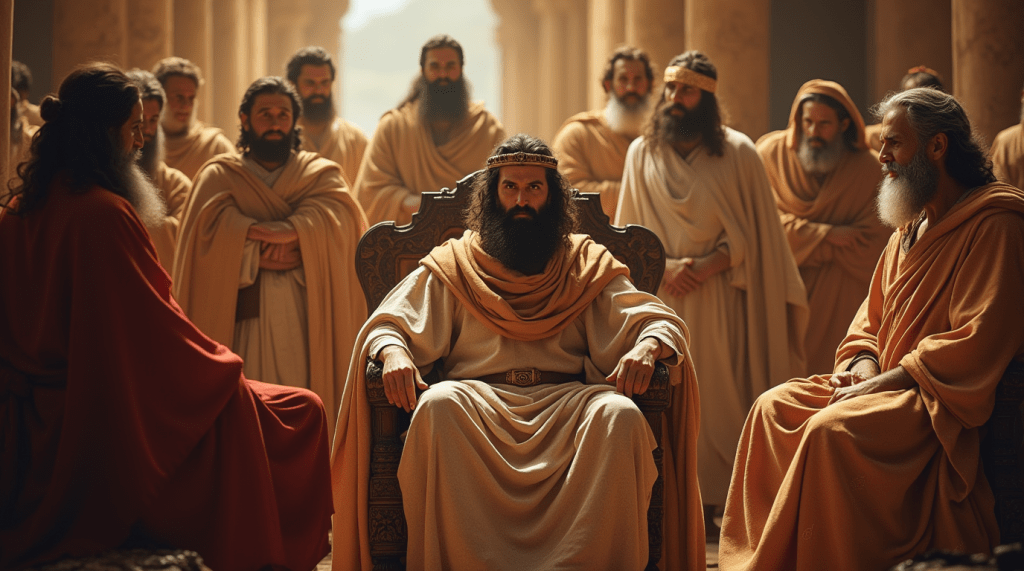
We might think of Saul as the wicked king who was always trying to kill David before David eventually succeeded Saul, and became the second king of Israel. But in the beginning, he was humble and even shy and fearful. Here’s part of an exchange between the prophet Samual and Saul when they first met:
“…And on whom is all the desire of Israel? Is it not on you and on all your father’s house?”
And Saul answered and said, “Am I not a Benjamite, of the smallest of the tribes of Israel, and my family the least of all the families of the tribe of Benjamin? Why then do you speak like this to me?” 1 Samuel 9:20-21
Saul’s response was almost exactly what Gideon’s was in Judges 6:15. Once again, God is choosing the smallest tribe, the least important family in that tribe, the most insignificant person in that family.
Once Samuel anointed Saul as king, he just went back to working for his father in his own house like nothing happened. When he returned home his uncle asked him where he’d been and he said looking for donkeys (which was true), but he said nothing about being anointed king of Israel. (1 Samuel 10:14-16)
Finally, Samuel gathered all the people to Mizpah, a place just north of Ramah, Samuel’s home town, which was north of Jerusalem. At this time, Jerusalem was called Jebus, and it was controlled by the Jebusites, not the Israelites. When Samuel, through God’s instruction, indicated Saul was to be king, no one could find him.
And Saul the son of Kish was chosen. But when they sought him, he could not be found. Therefore they inquired of the Lord further, “Has the man come here yet?”
And the Lord answered, “There he is, hidden among the equipment.”
So they ran and brought him from there; and when he stood among the people, he was taller than any of the people from his shoulders upward. And Samuel said to all the people, “Do you see him whom the Lord has chosen, that there is no one like him among all the people?” 1 Samuel 10:21-24
The Fall of Saul
The fact that Saul was hiding between supply carts when he was about to be crowned king in front of the people reveals a fearful and possibly insecure character, very different from young David marching out to face the giant Goliath a few years later. To give him the benefit of a doubt, that is a very overwhelming position to be in, for someone from a small tribe and family.
But it wasn’t long before Saul had to live up to the people’s expectations – “…that our king may judge us and go out before us and fight our battles.” 1 Samuel 8:20 The Ammonites came and surrounded the town of Jabesh in Gilead. The people there were afraid but the Ammonites said if they would not fight, they would put out everyone’s eyes and make them all blind. Saul heard about this in his town, Gibeah, further south.
“Then the Spirit of God came upon Saul when he heard this news, and his anger was greatly aroused.” 1 Samuel 11:6
1 Samuel 12 is Samuel’s address to the Israelites at Saul’s coronation. If you care to read it, pay particular attention to Samuel’s encouragement and warnings in verses 13-15, and 20-25. Samuel’s words here proved to be true over the next several hundred years and through the reigns of many kings.

Long story short, Saul fought battles against Israel’s enemies and was successful in driving them back. But he made a series of choices, driven by both pride and fear, that took him away from the Spirit of God’s influence and protection.
- First, he got impatient waiting for Samuel and offered a sacrifice as if he were a priest. He clearly wasn’t, being from the tribe of Benjamin, and only those from the tribe of Levi could be priests. This violated God’s instructions to Moses.
- Next, after being instructed to completely wipe out the Amalekites and not take anything from them, he spared King Agag and took a lot of their animals. God told Samuel that Saul was rejected as king for this disobedience.
- Saul ordered Doag the Edomite to kill 85 priests of God and their families, when one of those priests helped David
- Finally, during the last week of his life, before he battled the Philistines once again, he sought out a witch to bring back the spirit of the deceased prophet Samuel to get advice.
The prophet Isaiah, later on in Israel’s history, wrote:
“And when they say to you, “Seek those who are mediums and wizards, who whisper and mutter,” should not a people seek their God? Should they seek the dead on behalf of the living?” Isaiah 8:19
We might say, “Well, Saul wouldn’t have read this if it was written after his time”. But he should have known better because Israel did have the writings of Moses. And we see he DID know better from 1 Samuel 28:9. Here are some verses condemning what Saul did.
‘Give no regard to mediums and familiar spirits; do not seek after them, to be defiled by them: I am the Lord your God.”
‘A man or a woman who is a medium, or who has familiar spirits, shall surely be put to death; they shall stone them with stones. Their blood shall be upon them.’ ” Leviticus 19:31, 20:27
“When you come into the land which the Lord your God is giving you, you shall not learn to follow the abominations of those nations. There shall not be found among you anyone who makes his son or his daughter pass through the fire, or one who practices witchcraft, or a soothsayer, or one who interprets omens, or a sorcerer, or one who conjures spells, or a medium, or a spiritist, or one who calls up the dead. For all who do these things are an abomination to the Lord, and because of these abominations the Lord your God drives them out from before you.” Deuteronomy 18:9-12
The bottom line was that Saul disobeyed God, and little by little as Saul rejected God’s guidance, the Holy Spirit stopped guiding Saul. When Saul realized this, rather than seeking God again and repenting, he went to God’s enemy for knowledge and advice.
Let’s be clear that what the witch saw when Saul wanted her to call up the spirit of Samuel was not actually Samuel, but a demon appearing as the prophet. The message this spirit gave Saul did not instruct him to seek God and be reconciled to Him, but it was a message of condemnation and hopelessness.
The devil and his fallen angels whisper in the ears of people today that they have gone too far, or displeased God in some way that He can no longer listen to them or accept them. This is a lie, and the Bible tells us:
“And it shall come to pass that whoever calls on the name of the Lord shall be saved.” Joel 2:32 (quoted in Romans 10:13)


 God's Work with Planet Earth
Leave a comment