Just like the first two kings of Israel, Saul and David, the ends of the two worst kings were different. For Saul and David, the most obvious difference between them was Saul allowed himself to become harder and darker, and he did not repent. David also sinned and messed up badly, but when he recognized it, he was devastated and repented. David was forgiven and Saul was not. So let’s see if the same thing happened with these two kings, one in Israel, one in Judah, later in history.
The Evil of Ahab
Ahab ruled the ten tribes that were torn away from the House of David because of Solomon’s idolatry. Judah had its own parallel history, and the ends of Israel and Judah were also different, based on their rebellion or reform (or lack thereof).
Ahab’s father, King Omri, led Israel into idolatry during his twelve-year reign, so Ahab didn’t have a good starting place. Omri bought a hill and built on it the city of Samaria. In the interest of time and space, I’ll try to summarize how Ahab “provoked” the wrath of God.
- Married Jezebel, the daughter of the king of the Sidonians, who was a devout occult practitioner (1 Kings 16:30-31)
- Built a temple to Baal, with an altar and wooden image (1 Kings 16:31-33)
- Allowed Jezebel to massacre the prophets of God (1 Kings 18:4)
- Coveted Naboth’s vineyard. Naboth didn’t want to sell it. Jezebel framed Naboth to get him killed. Ahab took his vineyard. (1 Kings 21)

Mt. Carmel Showdown
After three and a half years of severe drought and famine because of Israel’s idolatry, God gave Ahab, and all Israel, a choice on Mt. Carmel:
“And Elijah came to all the people, and said, “How long will you falter between two opinions? If the LORD is God, follow Him; but if Baal, follow him.” But the people answered him not a word.” 1 Kings 18:21
So all day the 450 prophets of Baal danced, called to Baal, cut themselves with knives so that their blood gushed, to get this god’s attention. But no sign and no fire came.
Elijah repaired the altar to God, and dug a trench around it. Then he directed the altar, wood, and sacrificed bull to be soaked three times, with enough water to fill up the trench around the altar. Then he prayed that God would turn the hearts of the people back to Him.
“Then the fire of the LORD fell and consumed the burnt sacrifice, and the wood and the stones and the dust, and it licked up the water that was in the trench.” 1 Kings 18:38

Even after this miraculous display of God’s power as He answered Elijah’s humble prayer, Ahab remained hard-hearted, stubborn, and hypnotized by his witch wife, Jezebel. He did not repent and persisted in the evil pressed on him by the fallen angels playing gods and demanding worship that only belongs to the Creator.
God’s pronouncement because of Ahab’s stubborn refusal to confess his sin and repent:
“So I will make the house of Ahab like the house of Jeroboam the son of Nebat, and like the house of Baasha the son of Ahijah.” 1 Kings 9:9
The End of Ahab
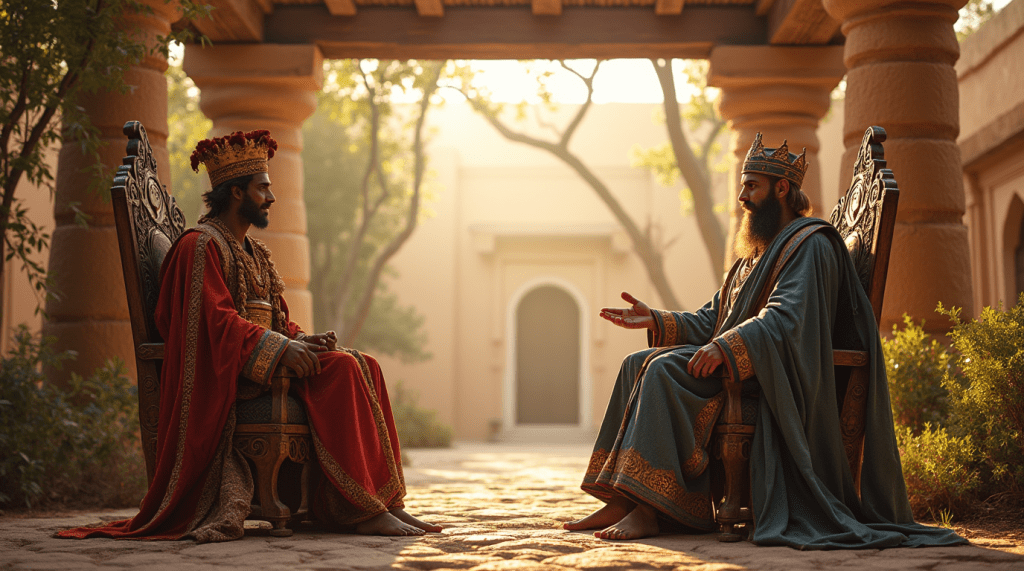
I am paraphrasing from 1 Kings 22. Jehoshaphat the king of Judah came to visit Ahab the king of Israel, and they were sitting on thrones by the gate of Samaria. Ahab says that Syria holds Ramoth in Gilead, which should belong to Israel, and asks if Jehoshaphat will help him fight Syria and take it back. Jehoshaphat says he’s up for it, but that they should ask the Lord if they should.
Ahab calls out hundreds of “prophets”, who say to go and fight and you’ll win! Jehoshaphat wasn’t fooled, and he knew these were prophets of a different “lord”, not prophets of God.
“And Jehoshaphat said, “Is there not still a prophet of the LORD here, that we may inquire of Him?”
So the king of Israel said to Jehoshaphat, “There is still one man, Micaiah the son of Imlah, by whom we may inquire of the LORD; but I hate him, because he does not prophesy good concerning me, but evil.” And Jehoshaphat said, “Let not the king say such things!” 1 Kings 22:7-8
So they bring Michaiah and tell him to tell Ahab what he wants to hear. So Michaiah in a mocking tone says “Yeah, go for it! You’ll win!” But Ahab says, “I want the truth!”
Then Michaiah gets serious, and relates a vision of God with the angels, asking which of them would convince Ahab to go to his death by attacking Syria. It seems the angels were muttering among themselves, but none of them really wanted to do this. Then a “spirit came forward” saying “I will persuade him”.
Then God asked this spirit, how will you do it? And this is what the spirit answered:
“The LORD said to him, ‘In what way?’ So he said, ‘I will go out and be a lying spirit in the mouth of all his prophets.’ And the LORD said, ‘You shall persuade him, and also prevail. Go out and do so.’” 1 Kings 22:22
Interesting. Just like in Job chapters 1 & 2, Satan and his angels have to get permission from God before they do something like this.
So Ahab listened to the majority, the false prophets inspired by an evil spirit, instead of the one true prophet warning him what would happen. And even though Ahab disguised himself so the enemy wouldn’t recognize him as the king, he caught a stray arrow between his plates of armor and bled to death in his chariot.
God keeps His promises
God had made promises to Adam and Eve, to Abraham, to David. And so even though both Judah and Israel fell repeatedly into idolatry and wickedness, God preserved a family line for the Messiah to be born into, which you can see in Matthew chapter 1. People make their choices, but God can still cause His will to happen. (Proverbs 16:9)
But this promise did not include the inhabitants of Sodom and Gomorrah, or Jeroboam, or Ahab. So God cut off the families of Jeroboam and Ahab (no more kings of Israel from them) because of their consistent rebellion and dedication to evil. But He made sure there was always a descendant of David on the throne of Judah. That is until Judah became so corrupt and wicked that God allowed Babylon to destroy Jerusalem and take them into captivity.
But eventually, Jesus, the King of Kings, was born into the tribe of Judah. The final fulfillment of God’s promises still hasn’t happened yet, but Jesus will one day replace all earthly rulers. (Daniel 2:44, Revelation 19:11-16)
The Evil of Manasseh
The story of King Manasseh is one that always makes me shake my head in amazement. How could God forgive, reconcile, and restore someone like this?
- While King Hezekiah, Manasseh’s father, had reformed from idolatry and broken down the altars to the false gods, Manasseh rebuilt them
- Manasseh “worshipped the host of heaven and served them” (fallen angels) (2 Chronicles 33:3)
- As if this wasn’t bad enough, he built altars to false gods and set up images to them inside the Temple of God. (He literally placed images honoring the rebel angels in the holy place of the Creator)
- He made his own children “pass through the fire” (pagan child sacrifice)
- “he practiced soothsaying, used witchcraft and sorcery, and consulted mediums and spiritists” (2 Chronicles 33:6)
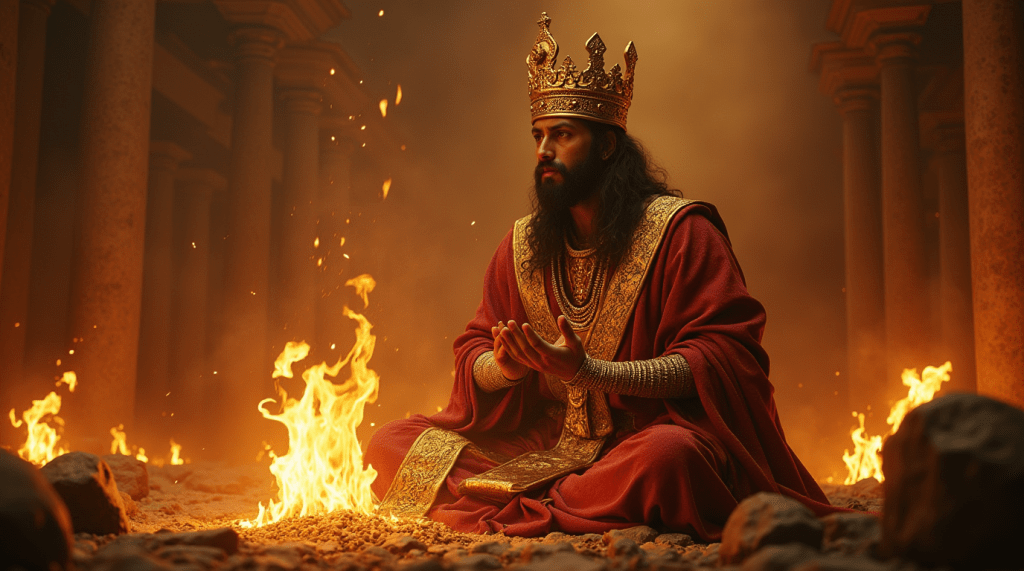
“Moreover Manasseh shed very much innocent blood, till he had filled Jerusalem from one end to another, besides his sin by which he made Judah sin, in doing evil in the sight of the LORD.”
“…Manasseh seduced them to do more evil than the nations whom the LORD had destroyed before the children of Israel.”
2 Kings 21:16, 9
Hebrews 11:37 mentions prophets being “sawn in two”. Non-Biblical books like “The Martyrdom of Isaiah” and “The Babylonian Talmud” say that King Manasseh ordered the prophet Isaiah to be sawn in half while he was hiding in a hollow tree. So while scripture doesn’t say this actually happened, it is a possibility.
Don’t you find it interesting that these false god’s were all about corruption, perversion, violence and destruction, while God was commanding “don’t murder, don’t deceive each other, don’t steal from each other, treat each other well and ensure justice in your society”? (see Leviticus 19:11-18)
As we saw from King Saul’s story, Judah and Israel had the books of Moses, as we do today, in our Bibles.
“Give no regard to mediums and familiar spirits; do not seek after them, to be defiled by them: I am the LORD your God.”
“A man or a woman who is a medium, or who has familiar spirits, shall surely be put to death; they shall stone them with stones. Their blood shall be upon them.” Leviticus 19:31, 20:27
There was a spiritual war for the souls of humans back then as there is today, and the only thing that has changed is technology and culture. Evil spirits are still convincing people to murder, deceive, steal, hate, destroy, and pervert good things.
The End of Manasseh
What happened to Manasseh in the end was brutal, but it wasn’t like Ahab. Assyria attacked Judah/Jerusalem and took Manasseh captive, tortured him, and threw him in a dungeon.
“Now when he was in affliction, he implored the LORD his God, and humbled himself greatly before the God of his fathers, and prayed to Him; and He received his entreaty, heard his supplication, and brought him back to Jerusalem into his kingdom. Then Manasseh knew that the LORD was God.” 2 Chronicles 33:12-13
So what did he do then, once God brought him back to his throne? He repented and changed. He took all the idols out of the Jerusalem, including the ones he had set up in the Temple. He destroyed all the idols and altars to pagan gods he had built and restored worship services at the Temple to God.
If we believe the Bible, it appears that even though Manasseh was so wicked, God did forgive and restore him, and we can expect to see him in Heaven, along with Nebuchadnezzar and the thief on the cross next to Jesus. So don’t ever doubt that God can forgive and save you no matter what you’ve done. Forgiveness requires confession (admit what you did wrong) and repentance (the Hebrew word means to turn around, change direction, return to a starting point). God supplies the power to change when we ask.


 God's Work with Planet Earth
Leave a comment