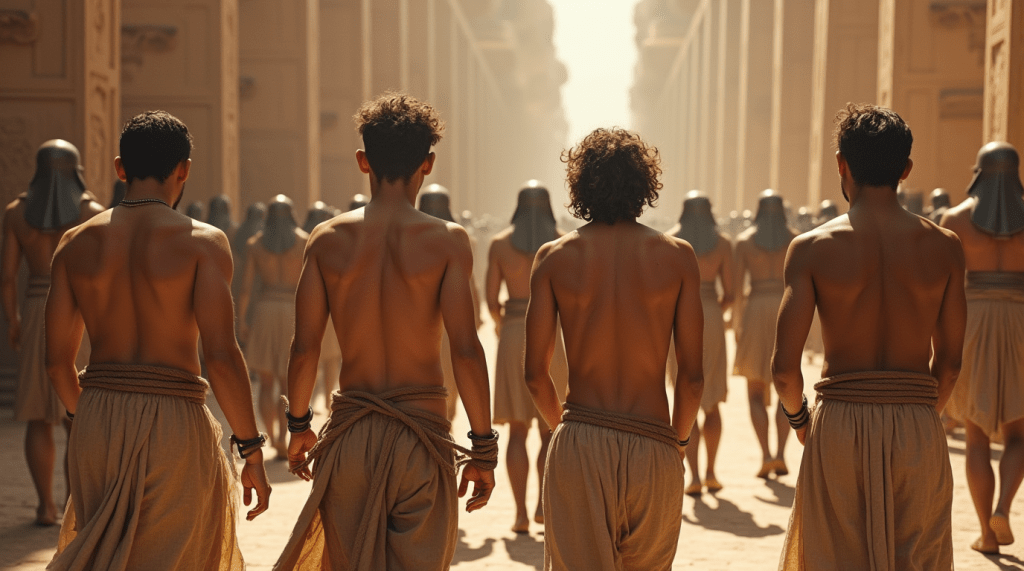
Before he finally destroyed Jerusalem for their rebellion in 586 BC, King Nebuchadnezzar took prisoners back to Babylon. Those who were educated and showed aptitude were selected for government service. Beyond the special and practical training involved, this involved being immersed into Babylon’s culture and religion. For those who still wanted to follow God, it was out of the frying pan and into the fire. They were going from a corrupted Judah to a pagan Babylon. This was what happened to Daniel and his three friends.
The Meanings of Names
“To them the chief of the eunuchs gave names: he gave Daniel the name Belteshazzar; to Hananiah, Shadrach; to Mishael, Meshach; and to Azariah, Abed-Nego.” Daniel 1:7
Isn’t it interesting that Isaiah 62:2 and Revelation 2:17 both say God will give His saved people new names? A new name is a new identity. And Babylon wanted to erase the old culture and beliefs of Judah in these young men by replacing it with their own pagan culture and beliefs.
Hebrew names:
- Daniel = God is my judge
- Hananiah = God is gracious, or God is favored
- Mishael = Who is like God?
- Azariah = Yahweh has helped, helped by God
Babylonian names:
- Belteshazzar = Bel protects the king (Bel = “Lord” or “Master” and was used to refer to the Babylonian god Marduk)
- Shadrach = Command of Aku (Babylonian moon god)
- Meshach = Guest of the king
- Abednego = Servant or slave of Nebo (Babylonian god of wisdom, learning and scribes)
There’s an obvious shift in focus from Israel’s God to Babylonian gods and the king. This wasn’t just training, this was their new names – their new identity.
The Test of Lifestyle
We’re not told what other things these four young men abstained from in Babylonian culture, but diet was the first test mentioned. The king himself had ordered what the new trainees for government service would eat. And at least some of it included wine and meats which were unclean for Jews.
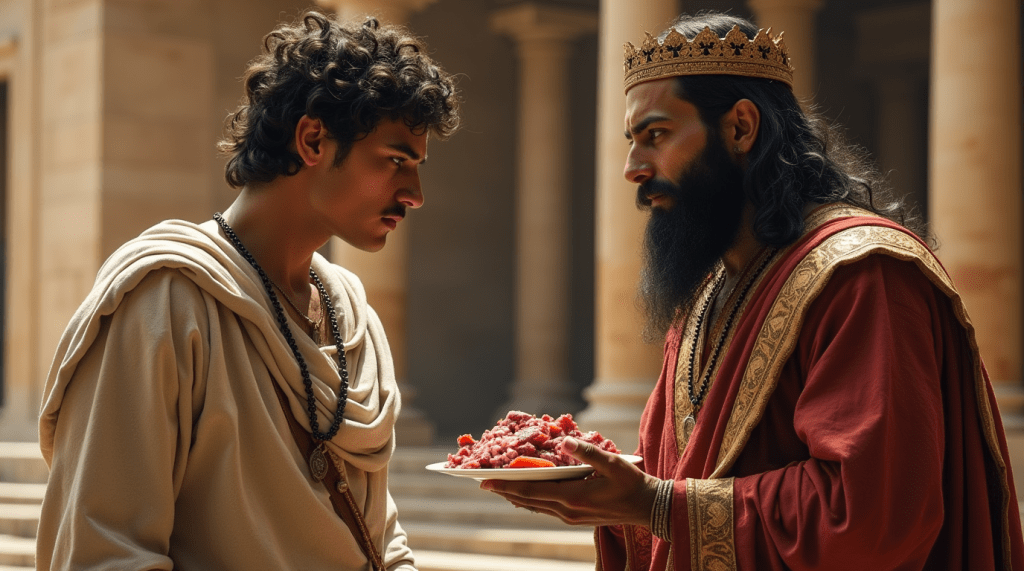
It’s important to note that Daniel respectfully and politely requested an exception from these forbidden foods, rather than arrogantly demanding his rights. But God was also involved:
“Now God had brought Daniel into the favor and goodwill of the chief of the eunuchs.” Daniel 1:9
Ashpenaz, the chief of the eunuchs, told Daniel he was afraid if Daniel didn’t eat what the king had ordered, and he and his three friends started looking malnourished. “You would endanger my head before the king”. Daniel’s request required a deviation from the diet the king had ordered, and if the chief eunuch disobeyed…
Daniel negotiated, saying can we just try this for ten days? Give us vegetables and water, and test us to see how we do. Ashpenaz agreed. The result was incredible, so I’ll just put up the entire quote:
“And at the end of ten days their features appeared better and fatter in flesh than all the young men who ate the portion of the king’s delicacies. Thus the steward took away their portion of delicacies and the wine that they were to drink, and gave them vegetables. As for these four young men, God gave them knowledge and skill in all literature and wisdom; and Daniel had understanding in all visions and dreams.
Now at the end of the days, when the king had said that they should be brought in, the chief of the eunuchs brought them in before Nebuchadnezzar. Then the king interviewed them, and among them all none was found like Daniel, Hananiah, Mishael, and Azariah; therefore they served before the king.” Daniel 1:15-19
The sequence is very clear here. Daniel and his friends obeyed God’s commands in the law of Moses, and God blessed them with wisdom so that they were so impressive to the king that he chose them to serve in his court. Just as God had promised all along, He rewards obedience with blessings and success.
Trial by Fire
God gave Nebuchadnezzar a prophetic dream about the history of the world empires that would follow Babylon until the end of time. It was an image of a man (an idol the pagan king would understand) with each section made of different metals.
But Nebuchadnezzar ruled the “civilized” world of his day, and he was proud and used to getting his way. He didn’t want another kingdom to take over, and he wanted to reign forever. So he made a massive, all-gold idol that was 90 feet tall. Then he organized a gathering where all the officials and leaders of the provinces must come and bow down before the image (which represented him and his kingdom).
Compromise would have been easy to rationalize. It’s just showing loyalty to the king, and its not really worship. But there were very specific, detailed, and repeated commands from God against making and bowing to images. Daniel wasn’t there, for whatever reason, but the other three were, and they were hauled before the king for not bowing when the music played.
King: Maybe you boys didn’t understand (forget that you’re the brightest new government employees in the whole land). You’re supposed to bow when the music plays. Shall we try again? And if you don’t, you’re going straight to hell!
Three men: Nope! No need to try again. God can save us. But even if He doesn’t, we still can’t betray Him by bowing to your idol.
Now the king, who no one dared to defy, was furious! Make that furnace seven times hotter, and throw them in. The Babylonian guards did their best to comply, so that when they threw the young men into the furnace, they fell down outside, dead from the radiant heat! And then the most awesome part of the story happened.
Then King Nebuchadnezzar was astonished; and he rose in haste and spoke, saying to his counselors, “Did we not cast three men bound into the midst of the fire?” They answered and said to the king, “True, O king.”
“Look!” he answered, “I see four men loose, walking in the midst of the fire; and they are not hurt, and the form of the fourth is like the Son of God.” Daniel 3:24-25
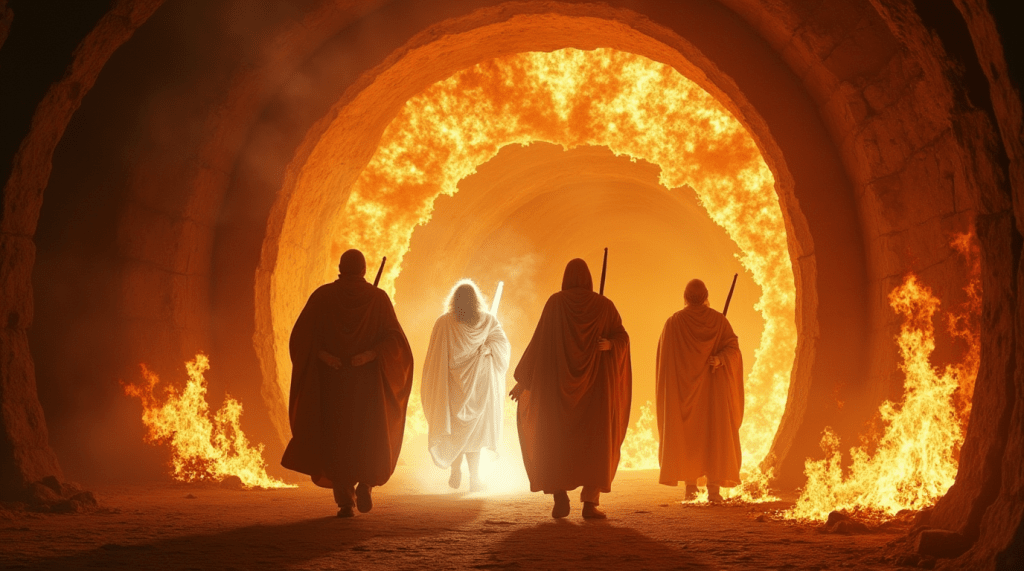
Now how would a pagan king know what “the Son of God” looked like? Just to be clear, the Aramaic words are “bar” (son) and “elahh” (God). So he didn’t mean “one of the gods” or “like a god”. Daniel served the king directly and God had given him the gift of dreams and interpretation (as He had with Joseph in Egypt), and Nebuchadnezzar had dreams as well. So it’s entirely possible that the king had seen a vision of the pre-incarnate Christ (before He took on human form as Jesus).
These three young men would have given their lives for their loyalty to God, and in response, Christ showed up to walk with them through the fire. The ropes that bound them were burned off, but their clothes and hair didn’t even smell like smoke when they came out. (verse 27)
Sometimes we’re in the furnace in this world, and our faith is tested. But if we keep seeking to follow God, the fire burns off the things that bind us, and the Bible describes a future new heaven and a new earth where, like the smell of smoke or singed hair, not a trace of sin, pain, suffering, death will remain.
The Test of Worship
As time went on, just like Nebuchadnezzar’s vision from God predicted, Medo-Persia conquered Babylon. Darius the Mede, after being informed of Daniel’s service and wisdom, set him up as one of three national governors over all the regional governors. The Persian governors weren’t too happy with a foreigner being their boss. And besides he had a weird, monotheistic religion. But they couldn’t find any fault with Daniel to get him in trouble. (Daniel 6)
As it often goes in politics, they flattered Darius into making a law that everyone in the kingdom must worship only Darius the king for thirty days. We need to be aware that pagan religions often teach that humans are descended from gods, or become gods. It’s an echo of the deception from Eden, “you will be like God”, and from Isaiah 14:13-14 where Lucifer wanted to be like God. So this wouldn’t be strange or blasphemous for them as it was for Daniel.

But Daniel had a custom of opening the window of the “upper room” of his apartment facing Jerusalem and praying three times a day. Since Babylon was east of Israel, in modern Iraq, Daniel would have been facing west in order to pray toward the Temple in Jerusalem. Pagan religions in Babylon, Egypt, and Rome worshiped the sun by facing east. So Daniel was swimming against the tide in more ways than one.
He could have started praying in an inner room where no one could see when this law went into effect. But he didn’t, and the princes were happy to finally catch him breaking their law, which they convinced Darius to sign.
The Medes and Persians had a rule that once the king made a law, it could not be changed, and we also see this in the story of Esther. It wasn’t like today in the United States, where Trump makes laws, Biden comes into office and undoes them, Trump gets elected again and undoes Biden’s laws and reinstates his own. So when Darius knew that he had been tricked into signing Daniel’s death warrant,
“And the king, when he heard these words, was greatly displeased with himself, and set his heart on Daniel to deliver him; and he labored till the going down of the sun to deliver him.” Daniel 6:14
Daniel knew about the law, and he knew the penalty was being thrown in a cave with hungry lions. He didn’t let that threat stop his publicly visible worship of God. The angels also know that only God deserves worship (Revelation 19:10, 22:9), not a man, not an angel.
After putting Daniel in the lion’s den, Darius could not sleep. He didn’t eat or have any music played for him all night.
“Then the king arose very early in the morning and went in haste to the den of lions. And when he came to the den, he cried out with a lamenting voice to Daniel. The king spoke, saying to Daniel, “Daniel, servant of the living God, has your God, whom you serve continually, been able to deliver you from the lions?”
Then Daniel said to the king, “O king, live forever! My God sent His angel and shut the lions’ mouths, so that they have not hurt me, because I was found innocent before Him; and also, O king, I have done no wrong before you.” Daniel 6:19-22
And King Darius hadn’t forgotten the treacherous, jealous governors who tricked him to get rid of Daniel. He had them thrown in the lions den where Daniel had spent the night, “and the lions overpowered them, and broke all their bones in pieces before they ever came to the bottom of the den.” (verse 24)
Our Future Test of Faith
In Revelation 13, at the end of time, there’s a similar ultimatum over worship. The second beast (or kingdom) says that anyone who doesn’t worship the image (the form or the copy) of the first beast, cannot buy or sell (economic sanctions), and eventually “must be killed”.
The problem is that this form of worship follows the first beast, which earlier in the chapter was given authority for a period of time, and speaks “blasphemy against God”, and “made war with the saints”. But if you’re not worshipping God in the way that God has commanded, then who are you really worshipping?
We’ll get to the outcome of this battle and ultimatum over worship in Stage 3 and 4. But we’re still in Stage 2 of God’s Work with Planet Earth and there’s still more to cover here before we move on.

 God's Work with Planet Earth
Leave a comment