The gospels in the New Testament have very few details about Jesus before He started His ministry at 30 years of age. But let’s take a look at what we do have.
Prophecies about Young Jesus
“Curds and honey He shall eat, that He may know to refuse the evil and choose the good.” Isaiah 7:15
- Who is the “He” referred to here? Verse 14 says it is “Immanuel” or “God with us”
- What’s the significance of “curds and honey”? It predicted Jesus’ humble upbringing.
- The Greek word “yada” means to become acquainted, to observe and discern or comprehend. Jesus learned about right and wrong, good and evil, just like every human child. He didn’t have this innate knowledge from birth.
“For He shall grow up before Him as a tender plant, and as a root out of dry ground. He has no form or comeliness; And when we see Him, there is no beauty that we should desire Him.” Isaiah 53:2
Isaiah was writing as inspired by the Holy Spirit, predicting Jesus’ humble and poor origins. And that He did not appear like a majestic prince, so that without faith, no one would suspect Him to be the Messiah.
“But You are He who took Me out of the womb; You made Me trust while on My mother’s breasts.” Psalms 22:9
“And the Child grew and became strong in spirit, filled with wisdom; and the grace of God was upon Him.” Luke 2:40

“‘The glory of this latter temple shall be greater than the former,’ says the LORD of hosts. ‘And in this place I will give peace,’ says the LORD of hosts.” Haggai 2:9
Why would the prophet Haggai say that the glory of the “latter” or second temple would be greater than the first? Especially considering that old Levites and priests who remembered Solomon’s temple before it was destroyed by the Babylonians, wept at the second temple’s dedication when they realized it didn’t hold a candle to the first! (Ezra 3:12)
In the tabernacle in the Sinai Desert, and in Solomon’s Temple, God’s presence dwelt in spirit. But when Jesus came to the second temple in Jerusalem, God was visiting in visible human form, talking with people face to face, touching them, healing them. Wasn’t this a better way to know God, as opposed to believing His spirit dwells behind a heavy curtain?
Okay, what about “in this place I will give peace”? It’s connected to these passages:
“And I will put enmity between you and the woman, And between your seed and her Seed; He shall bruise your head, And you shall bruise His heel.” Genesis 3:15
God was speaking to the serpent (Satan) who deceived Eve in Eden when He said these words. The seed of the serpent follow his lies and devote themselves to his evil ways. The seed of the woman (who represents God’s people) would follow God in spite of living in a sinful world. And these two groups cannot be in harmony or get along, because there has always been enmity between them.
“Because the carnal mind is enmity against God; for it is not subject to the law of God, nor indeed can be.” Romans 8:7
“Adulterers and adulteresses! Do you not know that friendship with the world is enmity with God? Whoever therefore wants to be a friend of the world makes himself an enemy of God.” James 4:4
Jesus’ sacrifice and death “in this place” (Jerusalem) provided a way for humans to be reconciled with God, in spite of this “enmity” or incompatibility between sin and holiness. Because of Jesus, we can have “peace” with God.
Jesus’ First Years
“So he came by the Spirit into the temple. And when the parents brought in the Child Jesus, to do for Him according to the custom of the law, he took Him up in his arms and blessed God and said: “Lord, now You are letting Your servant depart in peace, According to Your word; For my eyes have seen Your salvation which You have prepared before the face of all peoples, a light to bring revelation to the Gentiles, and the glory of Your people Israel.” Luke 2:27-32
God let multiple people know that the Messiah had arrived.
- Angels sang to shepherds
- Scholars from the east were led by scripture and signs in the sky
- Zacharias the priest was informed by an angel while doing his duties in the temple (Luke 1:5-20)
- Both Zacharias’ wife Elizabeth and her unborn baby (John the Baptist) knew when Mary came to visit them (Luke 1:39-45)
- In the preceding verses (Luke 2:25-26), the Holy Spirit told Simeon that he would not die before he saw Christ.
“When he arose, he took the young Child and His mother by night and departed for Egypt, and was there until the death of Herod, that it might be fulfilled which was spoken by the Lord through the prophet, saying, “Out of Egypt I called My Son.” Matthew 2:14-15
- Matthew is quoting Hosea 11:1, and drawing a parallel between the God freeing the Israelites from slavery to the Egyptians and God bringing Jesus back to Israel from Egypt after King Herod (who tried to kill Him) died.
- Joseph knew that Herod’s son reigned in his place, and God guided him to settle in Nazareth in Galilee, rather than returning to Judea. (Both Joseph and Mary were from the tribe of Judah, and descendants of King David.)
Not really an important detail, but Jesus was probably fluent in the Egyptian language, having grown up there during His toddler years, as well as Aramaic, Hebrew, and Greek.
Jesus’ Visit to the Temple at 12

When Jesus was 12 years old, He went with Mary and Joseph to Jerusalem for the Passover. Once the feast was over, they left with a traveling group for a whole day before they realized He was not with them. They returned to Jerusalem to search for Him.
“Now so it was that after three days they found Him in the temple, sitting in the midst of the teachers, both listening to them and asking them questions. And all who heard Him were astonished at His understanding and answers.” Luke 2:46-47
When they finally found Him, Mary expressed her anxiety over not being able to find Him, and He responded:
“And He said to them, “Why did you seek Me? Did you not know that I must be about My Father’s business?” Luke 2:49
Jesus wasn’t talking about Joseph’s carpentry shop, He was referring to His mission as the Messiah. After this visit to the Temple in Jerusalem when Jesus was twelve, Luke wrote this:
“Then He went down with them and came to Nazareth, and was subject to them, but His mother kept all these things in her heart.
And Jesus increased in wisdom and stature, and in favor with God and men.” Luke 2:51-52
Isn’t that interesting? The 12-year-old Messiah was “subject” (obedient) to His parents, just like any young person should be in a family. Years later, when John the Baptist protested that Jesus did not need to be baptized, Jesus responded:
“But Jesus answered and said to him, “Permit it to be so] now, for thus it is fitting for us to fulfill all righteousness.” Then he allowed Him.” Matthew 3:15
This confirms the idea that Jesus was living a life as an example for future believers. The way He conducted Himself is a lesson for us in how we deal with situations and how we treat people.
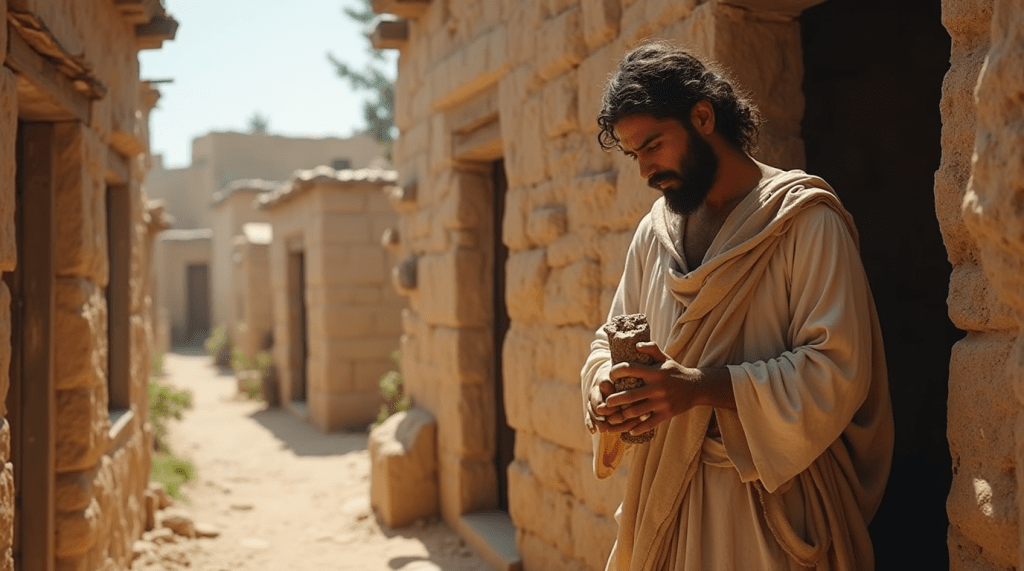
This is not in the Bible, but I believe the relationships Jesus formed, and the way He treated people, while in His teens and twenties prepared people to accept His messages once He started teaching and healing.


 God's Work with Planet Earth
Leave a comment